

2D game art outsourcing works best when output is reliable. Reliable output means assets land on time, stay consistent with the approved style, and integrate smoothly into production.
In practice, reliability shows up as fewer revision loops, faster approvals, and delivery packs that implement cleanly. It also shows up as consistent visuals across multiple assets.
This article breaks down a behind-the-scenes workflow that supports reliable output. After a game studio is done with the evaluation of a 2D game art service provider, the flow from there is like so: brief alignment, production planning, then three core stages of art production, with QA and approvals built into each stage.
With that framing in place, the workflow starts when the brief is sent out, then the 2D game art studio reviews it and returns a ballpark estimate. A clear brief keeps the quote stable, and it makes the next step, contract alignment, much faster.

Pre-production alignment
Before production starts, the workflow usually runs in two decision steps.
Before production starts, the studio reviews the brief and returns a ballpark cost range and timeline so both sides can align on feasibility. After the brief is confirmed, the studio issues a formal quotation, and once scope and schedule are agreed, production begins with a structured plan and task scheduling.
What are the essentials in an art brief?
A detailed brief does not need to be long. It just needs to be clear enough that the 2D game art studio does not have to guess. There are three must-haves:
First, include an asset list grouped by category, with quantities.
Second, add the detailed requirements. This can be short notes per category, covering art style, key details to keep, and the expected outcome. One to three bullet points per category is often enough.
Third, define the detail level with style references. For each category, include two to three references that show both style and complexity. Add a short note on how close the result should be, such as “close match” or “same vibe, simpler details.” This helps the outsourced studio estimate cost by tier, complexity, and effort more accurately.

Example of an 2D game art outsourcing brief
2D Game Art Production planning and control
This is where 2D art services become a system. After a detailed brief arrives, the workflow shifts from “art tasks” to production control. In structured pipelines used by those such as Thunder Cloud Studio, this is the control layer that keeps quality stable and delivery performance predictable for each quotation and project.
Two moves matter most at this stage. First, translate the brief into a plan that a producer can approve quickly. Second, lock a visual guide that becomes the reference point for every parallel contributor.
1. Planning tasks from the brief
After the required scopes of work are locked in place, the production manager breaks the brief into a plan that 2D artists can clearly follow. The output is simple: scope, effort assumptions, and a timeline that can be scheduled.
The plan usually includes:
- Tier and complexity assumptions
- Scope of work by asset category
- Stages needed for each category
- Quantity per category
- Timeline per asset type
- Total timeline per stage
Once the art director approves this plan, production starts. Tasks are assigned to individual artists with clear deadlines, milestones, and QA gates. From there, creative control shifts from “taste” to “rules,” so every decision can be repeated and audited as volume ramps.
Explore How 2D Game art outsourcing studio scales Production Without Losing Visual Consistency.
2. The production pipeline
The pipeline below is common in mature 2D art services. It keeps output moving while keeping style stable. Each stage has a different review shape, so teams can move fast without losing consistency.
2.1. Visual exploration
This stage is about decision speed, not polish. Fast exploration prevents expensive rework later because it locks direction early, while change is still cheap. Visual exploration focuses on aligning the direction with the game studio’s vision. The team explores a few clear variants, then converges on one direction that fits the narrative and gameplay context of the required assets.
Since this stage is all about gathering ideas and testing visions, it comes with multiple revision rounds that lead to adjustments, and requires flexibility and fast turnaround time from both sides.
From moodboards, reference images, early sketches, or paintovers, clients can give comments on target goals rather than brushwork to move work faster. Decide on silhouette and mood first, freeze one variable at a time, and avoid adding new reference packs mid-round.


2.2. Concept refinement
Once direction is approved, refinement converts taste into rules. Rules create repeatability, and repeatability makes scale possible.
This stage focuses on shapes, forms, and colors. Turning the vision into illustrations relies heavily on artistic judgment. The team uses the locked direction as the standard, and QA reviews keep the result close to that target.
Refinement also looks different by asset type. Characters often need readability zones and priority details, supported by a design sheet. UI needs spacing logic and state consistency, shown through layouts and mockups. Environments need depth layering and atmosphere rules that stay consistent across locations, supported by mood concepts and focused breakdowns where needed. For more details, read How Structured 2D Environment Art Systems Prevent Visual Drift.
Before mass production, freeze key decisions like rendering approach, line weight rules, highlight and shadow range, texture detail level, and edge treatment. Freezing does not kill creativity. It makes creativity repeatable.
2.3. Asset integration and optimization
At scale, delivery quality is not just visuals. It is how files behave inside production. Integration means the asset can be implemented without friction. Optimization means it stays usable after changes.
Two things matter most. First is revision-safe structure: layer logic that supports future tweaks, consistent naming, and traceable versioning. Second is delivery packs that survive handoff: clean folders, predictable exports, and source files that match what was approved.
Implementation-friendly habits reduce re-export time and protect future updates. Keep layers named by function, separate effects from base shapes, avoid destructive merges, and keep source and exports aligned.
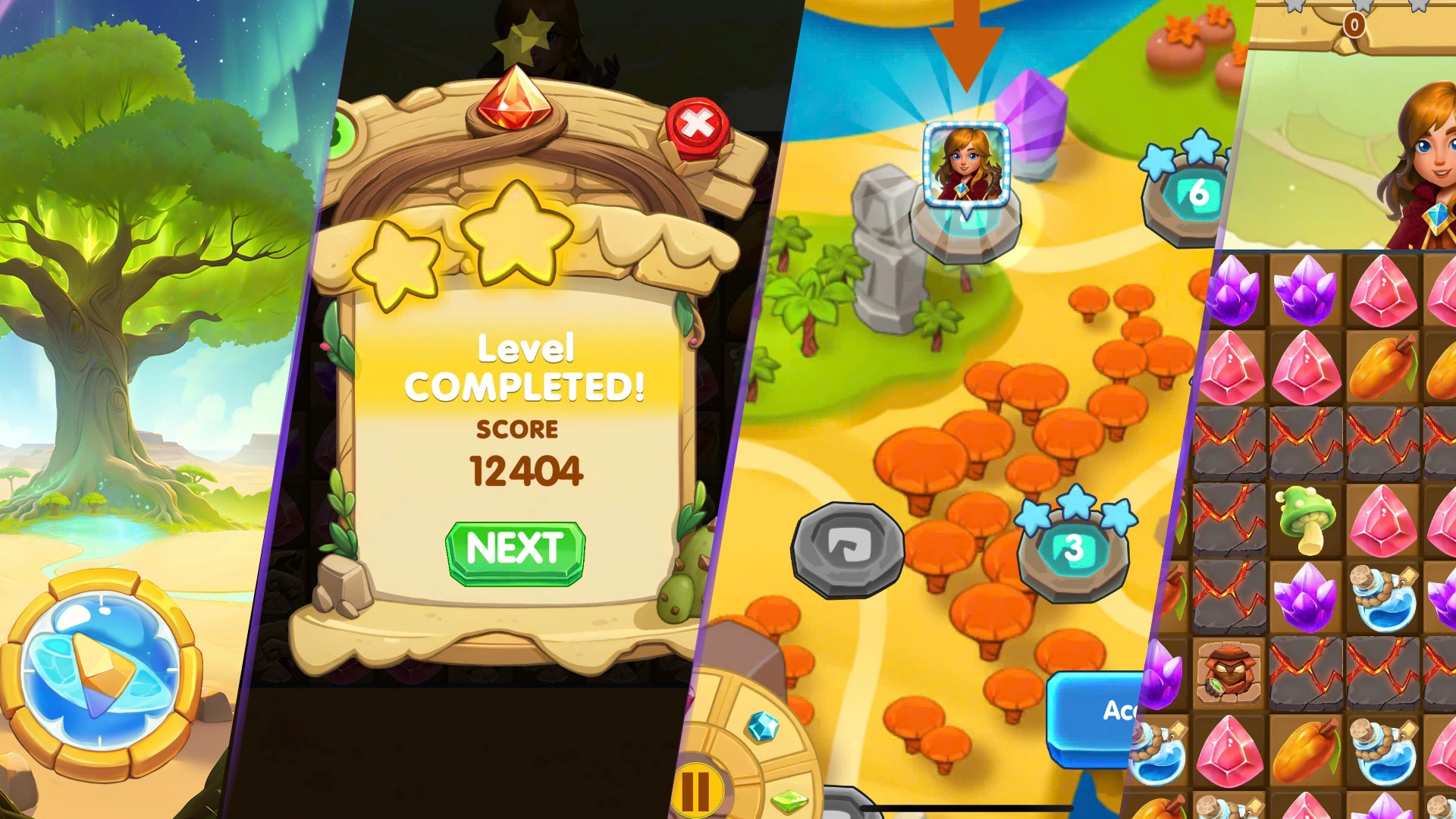
Explore Nova Match – 2D game art project to see Thunder Cloud Studio’s work from brief to final delivery
Common Failure Patterns in 2D Outsourcing Pipelines
Most production issues repeat. They show up when direction is treated as a one-time approval, and when delivery is treated as “final art” instead of a controlled system.
Direction drift after concept lock often happens when the rules are not written down, or when late feedback introduces new references. Immature vendors keep adjusting locally, then the batch slowly separates into multiple styles.
Revision loop explosion happens when feedback is fragmented, decision ownership is unclear, or “small changes” quietly expand scope. Without clear gates, teams keep polishing without moving forward.
Art style inconsistency in batch delivery shows up when artists work in parallel without a shared anchor. If a golden sample is weak or not enforced, each artist solves the same problem differently.
Missing integration specs create last-minute fixes. Files arrive with unclear layer logic, naming, exports, or implementation assumptions, and the integration team has to reverse-engineer intent.
These failure patterns are common in immature pipelines because control points are missing. A structured workflow prevents them by locking direction into repeatable rules, keeping approvals explicit, and catching variance early. That is also why QA cannot be “final review.” QA needs to run through the pipeline to prevent drift before it spreads.
Quality Assurance in every 2D game art production stage
In scalable 2D game art outsourcing, QA is one of the main defenses against visual drift. Drift usually starts small, then spreads across a batch when multiple artists interpret the same direction differently. QA is there to catch those differences early, while changes are still cheap.
Because style is not fully measurable, 2D game art QA relies heavily on artistic judgment. Reviewers compare new work against the locked art direction, moodboards, sketches, and approved references, then give specific internal notes to pull the asset back to the target. Game art production houses like Thunder Cloud Studio structure their QA in four layers, from close-to-the-work checks to division manager-level evaluation, so drift is corrected before it becomes a batch-level problem.
QA impact becomes visible over time as revision loops shrink and batch consistency improves. The key is not chasing perfect numbers. It is keeping drift small, so the batch stays aligned with the locked direction.
Client touchpoints and approval gates
Approvals are not bureaucracy. They keep production moving without rework loops. Each stage should end with a clear sign-off so the next stage can start with confidence.
In a typical 2D art services workflow, clients review and sign off at every stage. Feedback rounds are not capped, as long as requests stay within the agreed scope and direction. If feedback becomes a major change or new scope, it should be handled as a change request so timelines stay honest.
Most revisions usually happen during visual exploration, because this is where direction is still open. Once direction is locked, feedback should get narrower and more specific, focusing on matching the approved target rather than introducing new ideas.
Every change must be documented in detail, the 2D game art studio sends each delivery with a short studio note. The note highlights what changed, why it changed, and how the update stays aligned with the locked references and art direction. The feedback output from game developers should stay consistent, such as marked-up images, clear version labels, and a single consolidated feedback thread.
How to evaluate pipeline maturity quickly
Reliable output is easier to predict when the workflow is mature. Portfolio quality still matters, but delivery reliability comes from how the brief is translated into a plan, how direction is locked through the three production stages, and how QA catches drift before it spreads.
2D Outsourcing Pipeline Maturity Levels
What mature pipelines track (practical signals)
These metrics are common signals that QA and approval gates are working. They are not universal benchmarks, but they help studios compare workflow maturity across vendors.
- Average revision cycle: ~2 to 3 rounds
- Batch correction ratio: under 10%
- On-time delivery: above 95%
- Asset integration rework rate: under 5%
TL;DR
- Brief review leads to a ballpark cost range and timeline for feasibility.
- A formal quotation confirms scope and schedule before production starts.
- The brief is broken into tier and complexity, scope, stages, and stage timelines.
- Production flows through visual exploration, concept refinement, then integration and optimization.
- Multi-layer QA and approval gates prevent drift, rework loops, and inconsistent batch delivery.
A quick checklist helps: is the brief turned into tier and complexity assumptions, scope of work, and stage timelines, are approval gates clear at each stage, are QA layers in place to enforce the locked direction, and are delivery packs structured to stay revision-safe.
A mature 2D art outsourcing pipeline is not defined by portfolio strength alone. It is defined by how clearly direction is locked, how volume is controlled, and how drift is caught before it scales.
Studios evaluating external art partners can look beyond visuals and examine structural signals: planning assumptions, review layering, and integration discipline.
The difference between a vendor and a scalable production partner often lies in these invisible systems.