

Game art outsourcing is no longer a contingency plan. It is a core part of how modern studios build games. Today, many game art outsourcing companies and AAA game art studios provide specialized game art services that extend internal production capabilities. According to the 2026 XDS Insights Report on External Development, game art services remain the top external development offering at 62%, a significant increase from the previous year. Game studios are now sending more than 50% of their art production to external art partners. That share continues to grow.
With more game art outsourcing studios entering the market, the options are wider than ever. So is the variance in quality, process maturity, and delivery reliability. A strong portfolio gets a game art vendor onto a shortlist. What happens after that determines ROI. Communication, scope clarity, and production performance are the key variables.
This guide walks producers, art directors, and outsourcing managers through a structured process. It covers finding, evaluating, and onboarding a game art outsourcing partner. The scope includes concept art, 2D game art, 3D character, environment modelling, animation, and cinematic CGI.
The State of Game Art Outsourcing in 2026
Game art outsourcing is the practice of contracting external studios to produce visual game assets, from 2D concept art to 3D characters, environments, animation, and cinematic CGI, as an extension of a studio’s internal production pipeline.
In 2026, the demand for external game art services has rebounded strongly. After a dip in recent years, the art outsourcing sector is back at 2024 peak levels, with Developers across console, PC, and mobile committing a significant share of their art pipeline to external partners. The XDS 2026 report confirms that art remains the single most offered and most utilized discipline in external development.
That demand growth comes with a counterweight. Bad previous experience is now the number one reason internal teams decline to engage a new game art service provider, cited by 55% of developers and publishers, up 10% year over year. Communication challenges have risen sharply as the top friction point in active engagements. Game development companies are not becoming more tolerant of poor partnership experiences. The game development industry is becoming more selective at the front end.
This is exactly why the vetting process matters. The market has options. The role of producers and outsourcing managers is to separate game art vendors that deliver from those that only present well.
Where to Find Game Art Outsourcing Studios
In practice, sourcing the right game art outsourcing partner requires combining multiple discovery channels, each offering different validation signals.
Game art outsourcing companies are discoverable through several channels. Each one surfaces different types of external art partners and carries different trust signals.
Industry events and conferences
This remains the primary discovery channel for external development partnerships. Events like GDC and XDS bring game development studios and game art vendors into direct conversation, allowing internal teams to assess communication fit alongside creative capability before any formal engagement begins.
>> Read more: Thunder Cloud Studio attends XDS 2026 in Vancouver as a silver sponsor.
Internal vendor pools and referrals
These are the dominant trust channel for mid to large game companies. Many AA and AAA studios maintain curated databases of vetted game art service providers and reach out directly when a project scope matches a vendor’s capabilities.
It is recommended by Carl Schmidt in his GDC Roundtable about External Development (Outsourcing) in game dev that when reviewing or curating vendor pool entries, internal teams should have thorough, up to date documentation from each game art service provider, including pipeline overviews, art scope examples, clear process breakdowns, etc. Internal teams use these materials to assess how an external art partner operates before engagement. Vendor pool owners should also maintain and periodically audit these records to ensure each listed game art vendor still reflects current capabilities, team structure, and delivery standards.
Portfolio platforms and marketplaces
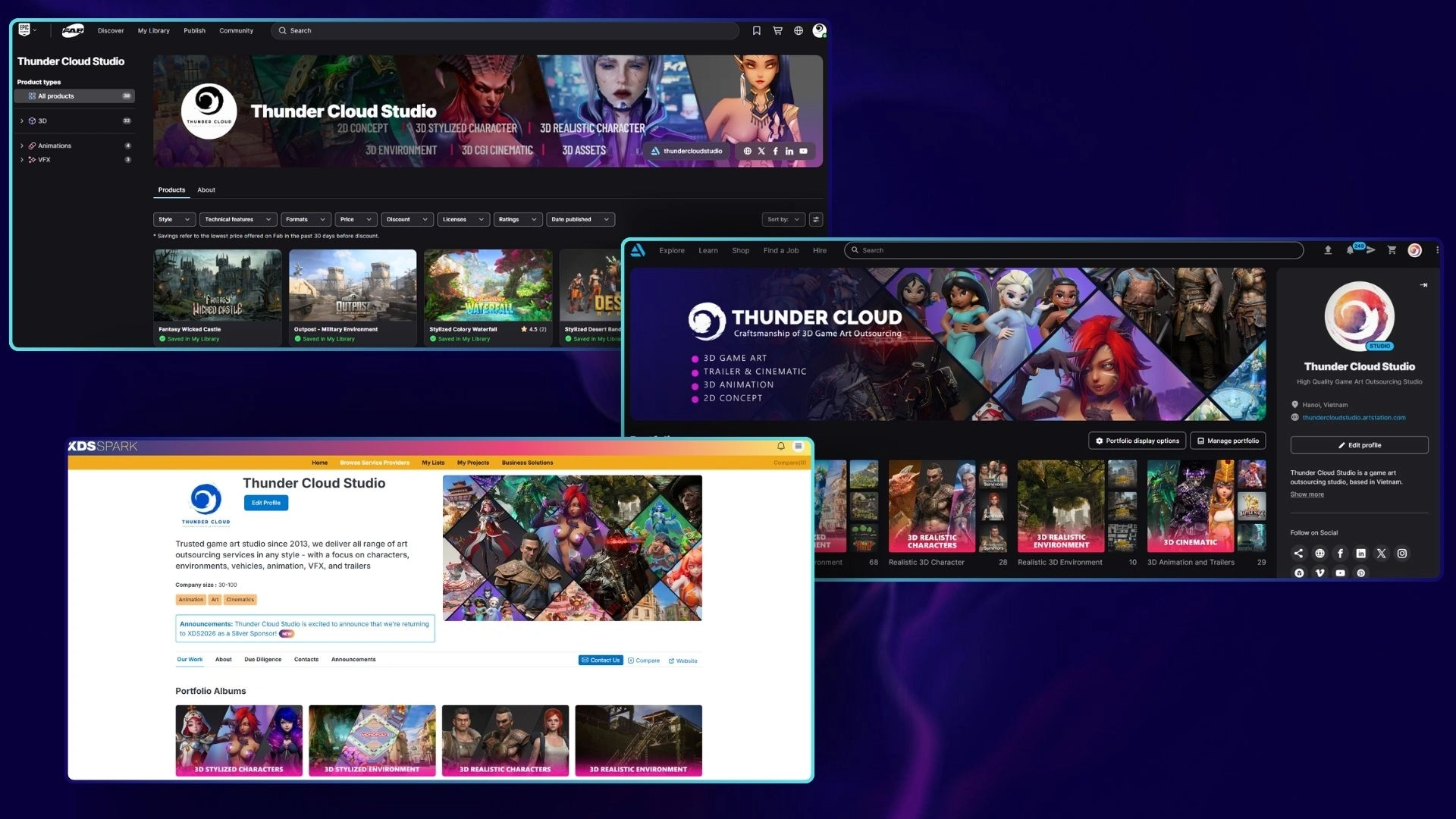
Portfolio platforms such as ArtStation, Behance, and Sketchfab are widely used by studios to scout potential game art outsourcing partners, with ArtStation being the most prominent due to the strong presence of established game art vendors and AAA-facing studios.
In parallel, B2B platforms such as XDS Spark and Game Caviar are increasingly used to connect game development companies with vetted service providers through structured networking and matchmaking.
Marketplaces such as Epic Games FAB (unifies Quixel, Sketchfab, Unreal Engine Marketplace, and ArtStation Marketplace) have also become an important discovery channel, with strong year over year growth and adoption. These platforms allow internal teams to review portfolios, validate style fit, and in some cases purchase ready made assets to test production quality before committing to a custom engagement. Studios like Thunder Cloud Studio also treat platforms such as FAB as a low friction entry point, allowing potential partners to experience asset quality and pipeline standards before scaling into full production.
>> Visit Thunder Cloud Studio’s Artstation, FAB, XDS Spark.
Online search and inbound
This channel continues to close the gap on referral led discovery. Game art outsourcing studios investing in content and visibility are increasingly findable through organic search, making it a viable channel for sourcing partners outside an existing network.
>> See top 5 game art outsourcing studios in Asia
What to Evaluate Beyond the Portfolio
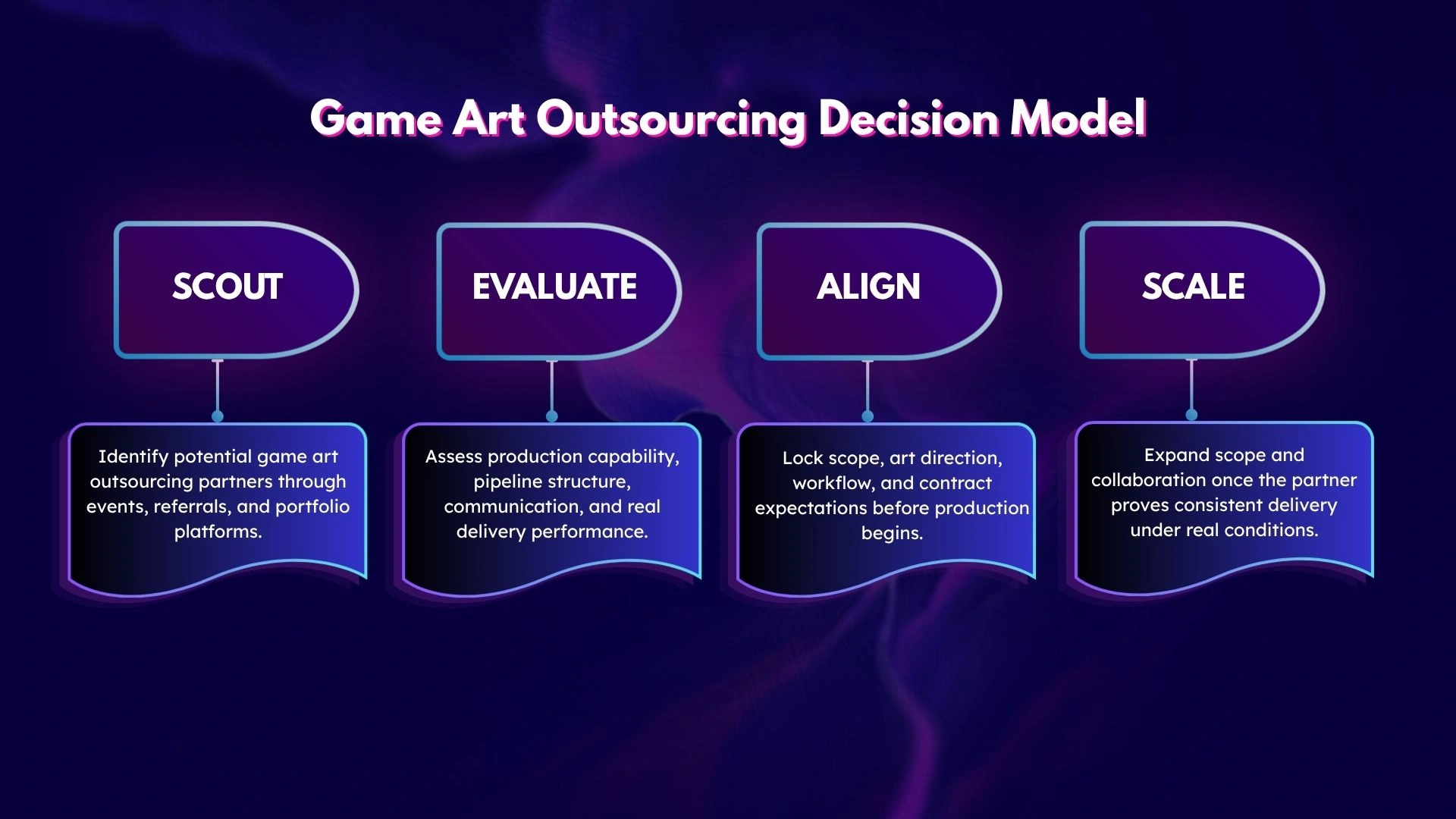
However, finding game art outsourcing companies is only the first step. The real decision happens during evaluation, when internal teams assess whether a vendor can perform under production conditions.
Portfolio review is the first filter, not the final one. Normally, the evaluation questions that matter most come after the visual review.
Production process and pipeline structure
Internal teams should ask any prospective game art outsourcing studio to walk through its delivery process.
- How are feedback stages structured?
- What are the milestone gates?
- How is revision scope handled?
A game art service provider with a documented, repeatable pipeline protects both sides from scope creep and timeline slippage. For example, some studios structure engagements around milestone based stages consistently across 2D art, 3D production, animation, and cinematic CGI workflow. A defined process is not overhead. It is the mechanism that keeps production predictable.
Communication and coordination infrastructure
Communication is the fastest rising friction point in external development partnerships. It is now the top issue reported during active engagements, ahead of delivery delays and cost disputes. When evaluating a game art outsourcing studio, internal teams should identify the named point of contact for the project.
- How are feedback rounds structured?
- What is the expected turnaround on revision requests?
- How are time zone gaps handled?
A dedicated project coordinator or project lead assigned per client is a meaningful differentiator. A shared inbox and a rotating roster of contacts is a structural risk.
Pilot test
Before committing to a full production engagement, game development companies should always request a paid pilot task. It is also often conducted even with recurring partnerships when scopes expand, such as from concept to 3D modelling, from animation expanding to VFX,… This is one of the most effective ways to assess real communication quality, following creative direction, and feedback handling in a low stakes environment. A pilot test reveals how the external art partner interprets a brief, how questions are raised when direction is unclear, and how feedback is handled when significant rework is required. The quality of the pilot output matters. How the game art vendor handles the process of getting there matters equally.
Scope flexibility and pipeline range
Most game development companies begin outsourcing within a single discipline or a paired combination, concept art and 3D modelling, or modelling and animation, or progress as the development roadmap. By doing this, game studios can evaluate how their partner executes within the initial scope and adapts accurately to the production direction.
As confidence builds and the partnership matures, scope can expand. A vendor that covers multiple disciplines, 2D concept, 3D modelling, animation, and full cinematic CGI, reduces handoff complexity and makes that expansion smoother. A studio like Thunder Cloud Studio operates across these service lines, allowing long term partners to consolidate more of their game art pipeline within a single production relationship without sacrificing quality at any stage. Balancing scope with budget remains a consistent challenge in game art outsourcing, and approaches to this are often documented in dedicated guides such as Game Art Quality vs Budget Optimization.
Track record at comparable scale
Portfolio visuals can demonstrate style and technical capability. However, it does not demonstrate the ability to deliver 200 assets on a compressed timeline while managing three rounds of feedback from a distributed internal team. Internal teams should ask for references from projects with comparable asset volume, team size, and deadline pressure. Named clients with specific deliverables carry more weight than anonymized samples. Longevity is also a useful baseline filter, but it needs to be paired with evidence of comparable execution.
Contract Types and What to Lock Down Before Production Starts
At this stage, alignment shifts from evaluation to execution. Contract structure and production expectations must be clearly defined before work begins.
Getting the contract structure right before production begins is one of the highest leverage decisions in a game art outsourcing engagement.
1. Contract models
The following models dominate most game art outsourcing engagements:
Retainer (dedicated team) model provides ongoing capacity where the game art outsourcing company allocates a stable, named team to the game development company over a fixed period. The external art partner manages staffing, training, and QA, while the internal team directs priorities and reviews. This model is common in long-term collaborations with AAA game art studios and supports continuity, scalability, and predictable throughput.
Asset based contracts price work per defined deliverables (for example, per character, environment, or animation set) against an agreed asset list, typically with milestone checkpoints for batches. This model suits high-volume production with repeatable asset types and stable art direction. It can introduce friction if direction changes mid-production, as revisions may alter unit scope without a clear adjustment mechanism.
2. Internal alignment before contract
Before engaging any external art partner, internal teams should align on the following:
- Feedback consolidation process, ensuring a single point of approval to avoid fragmented input and timeline delays
- Internal team involvement model, defining how much the internal team participates in reviews, feedback cycles, and art direction decisions
- Art direction lock, ensuring visual direction is clearly defined and approved before production starts to avoid changes mid stage
- Revision discipline, agreeing internally on expected feedback depth per round before sending to the external partner
3. What to confirm with the game art service provider
Internal teams should clarify the following with the vendor:
- Scope boundaries, including what constitutes an in scope revision versus an out of scope change request
- Revision round structure and what level of feedback is expected per round
- QA structure, how the game art service provider reviews deliverables internally before client delivery, and what the quality gate process looks like
- The team structure, including the primary point of contact, assigned roles (project lead, art lead, account manager), and responsibility distribution
- IP ownership terms covering all deliverables from the first draft forward
- Escalation process for direction changes that affect scope, timeline, or cost
It is also worth running a small pilot task within the contract structure before full production begins, or as a precursor to signing. A paid pilot tests how the game art partner handles revision feedback, scope interpretation, and communication under the actual terms of the agreement, not under the optimistic conditions of a sales conversation.
Red Flags to Identify Before Signing
Even with strong evaluation and alignment, certain signals should immediately raise concern during vendor selection.
The best time to identify a problematic partnership is during the discussion and contract review stage. These signals rarely improve once production is underway.
Poor communication signals
Language barriers, slow follow ups, unclear responses, or inconsistent points of contact are early indicators of coordination issues. These problems tend to scale with production and directly impact delivery timelines.
Lack of preparation from the game art outsourcing partner
When a service provider presents a generic portfolio that does not match the required skillset or service scope, it reflects a lack of effort in understanding the project needs. Studios that do not do the homework at the proposal stage are unlikely to align effectively during production.
Strict revision caps with overage charges baked into the base contract
A contract that hard caps feedback rounds and charges overages is a red flag. It shifts risk onto the internal team and can force premature approvals or additional costs when stakeholder availability delays consolidated feedback. When overage fees are tied to basic iteration, the incentive can tilt toward incomplete work rather than aligned delivery. In practice, feedback should not be rigidly capped; the process should allow necessary iteration to reach the agreed quality bar. At the same time, best practice is to run efficient cycles of roughly two to three well consolidated rounds, with clear, detailed feedback each time to avoid rework and scope drift.
Quality risks
External art partners that cannot clearly explain how they ensure quality consistency and scalability should be treated with caution. This is usually reflected in weak or missing QA structures, unclear review layers, or undefined team responsibilities.
Security and compliance gaps
A game art service provider that cannot demonstrate basic due diligence around security, access control, or is unable or unwilling to sign standard NDAs introduces immediate risk for production collaboration.
What a Reliable Game Art Outsourcing Partnership Looks Like
The external development partnerships that deliver consistently over time share a common structure, a defined delivery process, a dedicated point of coordination on the game art outsourcing partner side, and a track record that demonstrates the studio can adapt to production direction without losing momentum.
Examples of this can be seen in long term external art partnerships across the industry, where consistency and structured collaboration take priority over short term delivery. Thunder Cloud Studio, for instance, has been involved in ongoing collaborations with partners such as Scopely and 3D Clouds since 2023, supporting continuous production across their game portfolios. On the cinematic side, the studio has also worked within retained partnership models with groups like Modern Times Group, contributing to projects across InnoGames, Ninja Kiwi, Hutch, and Snowprint Studios. These types of engagements typically operate with dedicated coordination roles and stable game art pipelines, which are key to sustaining quality over time.


For internal teams evaluating potential partners, it is often useful to review how professional AAA game art outsourcing services structure long term collaborations, from pipeline design to coordination models and QA systems. Studying these patterns can help inform more effective vendor selection and onboarding decisions.
Game Art Outsourcing: Frequently Asked Questions
According to the XDS 2026 Insights Report, the most common onboarding window is one to three months. However, 39% of developers and publishers report onboarding taking longer than three months, with 13% extending to six to nine months. Onboarding timelines are affected by contract complexity, IP and security agreement processes, pipeline integration, and the volume of documentation required to align on art direction. Running a paid pilot task before full onboarding can reduce alignment risk and shorten the ramp up period once the full engagement begins.
A game art outsourcing studio provides structured production capacity across a team, typically including project management, art direction, QA review, and dedicated delivery coordination. A freelancer provides individual skills without the surrounding production infrastructure. Game art outsourcing studios are better suited to high volume, deadline driven production with multiple asset types. Freelancers are well suited to narrow scope tasks where direct collaboration with an individual artist is preferable.
A game art outsourcing contract should define the scope of deliverables, milestone structure and payment gates, revision round limits and what constitutes an out of scope change, feedback consolidation expectations, QA review process, IP ownership of all deliverables, and an escalation process for direction changes that affect scope or timeline. Retainer based and asset based contracts are the two most common structures used in the industry.
Game art outsourcing costs vary based on discipline, asset complexity, volume, studio location, and delivery timeline. According to industry observations, the market has reached a pricing floor after several years of downward pressure, with rates largely stabilized across most art disciplines. Blended day rates vary significantly by studio scale and specialization. Requesting a detailed scope estimate tied to specific deliverables is the most reliable way to benchmark costs against a project budget.
Game development companies can outsource most stages of the art pipeline. Common disciplines include concept art, 2D game art, 3D character and environment modelling, texturing, rigging, animation, and full pipeline cinematic CGI production. Many studios begin with a single discipline and expand scope within a partnership as the working relationship matures.
Game art outsourcing is the practice of contracting external studios or artists to produce visual assets for a video game. This includes concept art, 2D game art, 3D modelling, character and environment art, animation, and cinematic CGI. Game developers use game art outsourcing to access specialized skills, scale production capacity, and manage costs without expanding their permanent headcount.