

The game industry is under increasing pressure to deliver more content with fewer internal resources. At the same time, the rapid growth of the game art outsourcing market shows that outsourcing has become a strategic production choice rather than a tactical option.
For medium to large studios, choosing the right 2D art outsourcing partner directly affects timelines, budgets, and final product quality. Yet a significant number of outsourcing engagements fail due to communication gaps and quality misalignment.
This article presents a practical framework to help studios evaluate and select a 2D game art outsourcing partner with greater confidence.
- Why Choosing the Right 2D Game Art Outsourcing Partner Matters
- Understanding the Full Scope of 2D Game Art Outsourcing Work
- Preparing for a Successful Outsourcing Partnership
- The Vendor Evaluation Framework: A Phased Decision-Making Process
- Do’s and Don’ts for Working with a 2D Art Outsourcing Partner
- Red Flags vs Green Flags: Vendor Signals at a Glance
- Final Takeaway
Why Choosing the Right 2D Game Art Outsourcing Partner Matters
Modern game production depends heavily on external partners. Internal teams are leaner, development cycles are shorter, and content demands continue well beyond launch.
In this environment, 2D game art services (link đến bài flagship) must deliver more than attractive visuals. They must be consistent over time, scalable across production phases, and predictable in both quality and delivery.
A vendor that performs well during early concept exploration may struggle when asked to produce hundreds of assets under tight constraints. These failures often surface late, when rework is expensive and schedules are fragile.
Choosing the right partner early reduces downstream risk. It stabilizes production and protects creative intent over the life of the project.
Understanding the Full Scope of 2D Game Art Outsourcing Work
Before evaluating vendors, studios need a shared understanding of what illustration-driven 2D game art outsourcing actually involves. Misalignment at this stage often leads to downstream issues in quality, cost, and timelines.
How 2D Illustration Outsourcing Actually Works in Production
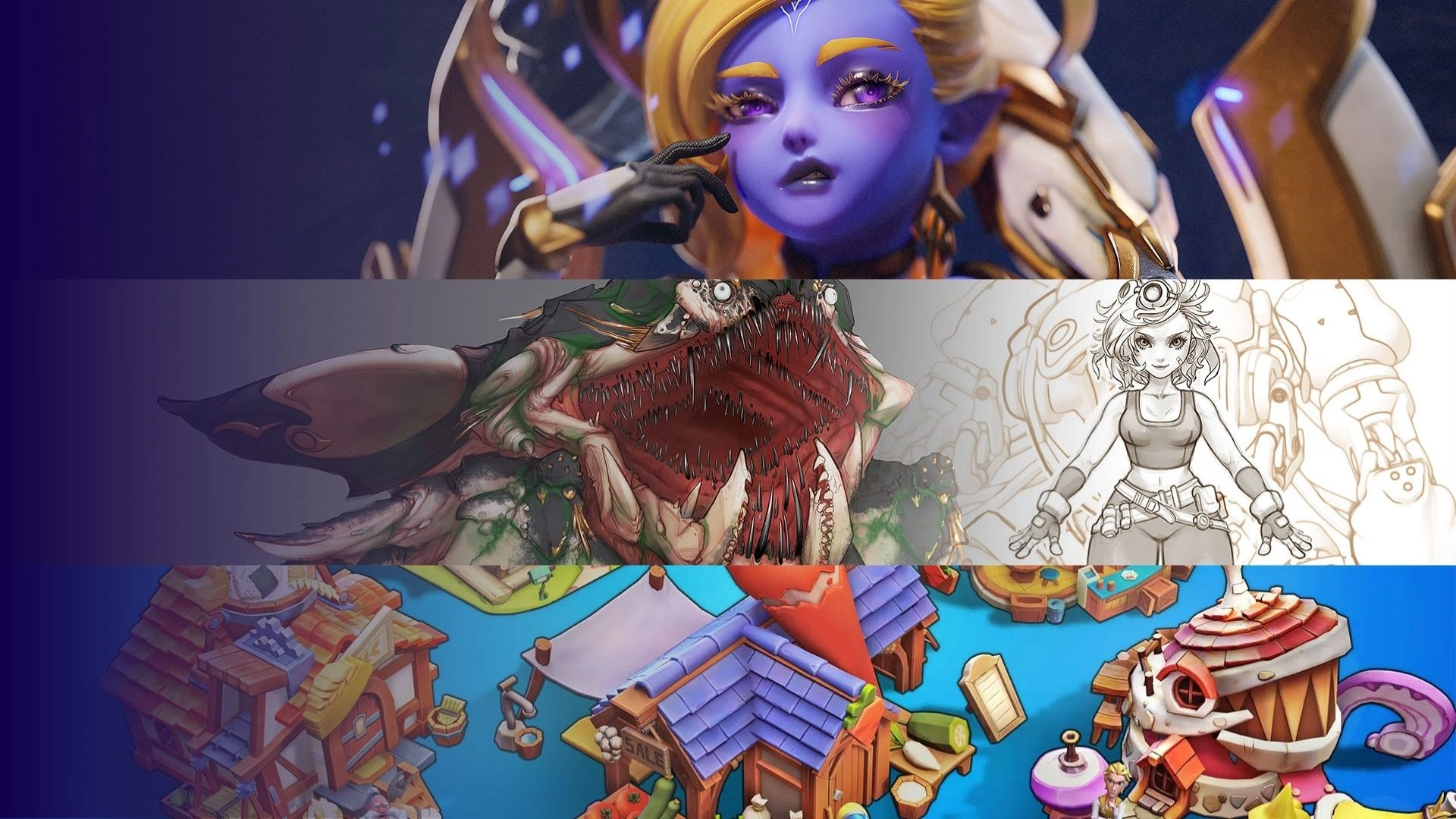
In practice, illustration-focused 2D game art outsourcing covers in-game characters, environments, supporting assets such as props and icons, UI-related visuals, narrative cutscenes, and selected marketing visuals or key art when needed. Clear scope definition prevents assumption gaps and ensures vendors are evaluated against real production needs.
What differentiates vendors is not asset type alone, but how they handle complexity and workflow. Asset complexity directly affects timelines, cost, and review depth, making it critical for studios to align visual references early so vendors can match the correct quality level or move directly into pilot execution.
Most mature studios operate with a staged workflow to keep iteration efficient. At Thunder Cloud Studio, this typically progresses from sketch alignment, to rough color and mood lock, and finally polishing for visual cohesion. Understanding whether a vendor follows a similarly structured workflow helps studios assess feedback control, iteration discipline, and production predictability.
2D Game Art Service Cost: Thinking Beyond the Numbers
Cost evaluation in 2D game art outsourcing should focus on drivers, not just final quotes. Two vendors with similar rates can produce very different outcomes depending on underlying assumptions.
In most projects, cost is driven by a combination of asset complexity and volume, scope clarity, expected revision depth, production timeline, and the level of communication and management required.
Studios that evaluate cost through these variables make more informed decisions and avoid false savings.
For a deeper breakdown of how these factors influence pricing, see the detailed cost analysis in our 2D game art outsourcing cost breakdown article.
Preparing for a Successful Outsourcing Partnership
Before committing to outsourcing, studios should first confirm whether outsourcing is the right choice at this stage. We explore this decision in more detail in our guide on when to outsource 2D game art vs keeping it in-house.
Before evaluating vendors, studios should invest time in preparation. Well-prepared teams consistently experience smoother collaboration, more accurate quotes, and faster alignment during pilots and production.
Key preparation steps include:
- Detailed art brief: Provide clear visual examples of the desired artistic direction, style, and quality level. Referencing an existing game with art style and polish closest to expectations helps vendors interpret intent accurately and estimate scope more reliably.
- Clear quality references: Separate inspirational references from execution references. Highlight which elements should be matched and which are for mood only.
- Asset list for the pilot: Prepare a concrete list of assets for the pilot project, including item types and quantities. This helps vendors plan effort, staffing, and timelines realistically.
Studios that prepare these materials upfront reduce ambiguity, improve quote accuracy, and create a stronger foundation for long-term collaboration.
The Vendor Evaluation Framework: A Phased Decision-Making Process
Choosing a 2D game art outsourcing partner should be approached as a structured decision, not a subjective preference. Each phase helps studios reduce risk before committing to full-scale production.
Phase 1 – Initial Screening and Strategic Fit
The first step is to eliminate misaligned vendors early.
Studios should start by reviewing portfolios to confirm basic visual compatibility with the game’s genre, tone, and complexity. Because most professional 2D game art service providers operate under NDAs, public portfolios rarely show their strongest work. Requesting tailored samples or short case studies often provides a more accurate signal of production capability.
Beyond visuals, studios should evaluate operational readiness. Vendors should be able to clearly explain team allocation, workflows, communication structure, and how collaboration will be managed in real production scenarios.
At this stage, discussing ballpark cost is also important. The goal is not detailed pricing, but confirming whether the vendor’s cost range aligns with the project roadmap before investing further time.
Before moving to pilots, studios should align expectations on three fundamentals: asset scope, quality thresholds, and production assumptions. Misalignment at this stage often causes outsourcing failures later, even when vendors appear technically capable.
From first contact to contract and production kickoff, this screening phase typically spans two to four weeks, depending on decision speed and vendor capacity.
Phase 2 – Pilot Project Validation
The pilot phase is where assumptions are tested through real work.
Studios should select two to three representative assets from the actual pipeline and run a short, structured pilot using the same briefing, feedback, and delivery process planned for production.
During the pilot, teams should evaluate:
- Turnaround time and delivery reliability
- How feedback is interpreted and applied
- Creative problem-solving and proactive suggestions
- File organization, naming, and handoff quality
Clear expectations around asset naming conventions, versioning, and folder structure are especially important at this stage. Consistent file structure and predictable versioning reduce integration friction and signal whether a vendor is prepared for long-term, high-volume production.
Most pilot projects run for two to three weeks, depending on asset complexity. This timeframe is usually sufficient to validate working rhythm without delaying production.
Phase 3 – Long-Term Collaboration Fit
Long-term fit becomes clear after onboarding and early production.
Studios should assess whether the vendor scales reliably beyond the pilot by observing consistency across multiple deliveries, communication clarity under pressure, and the ability to adapt to evolving requirements.
Strong long-term partners demonstrate stable quality, predictable processes, and proactive collaboration as production volume increases. These signals often matter more than early visual impressions when evaluating suitability for sustained production.
Do’s and Don’ts for Working with a 2D Art Outsourcing Partner
The table below reframes common outsourcing mistakes into clear do’s and don’ts. It highlights how studio-side decisions directly affect outsourcing outcomes.
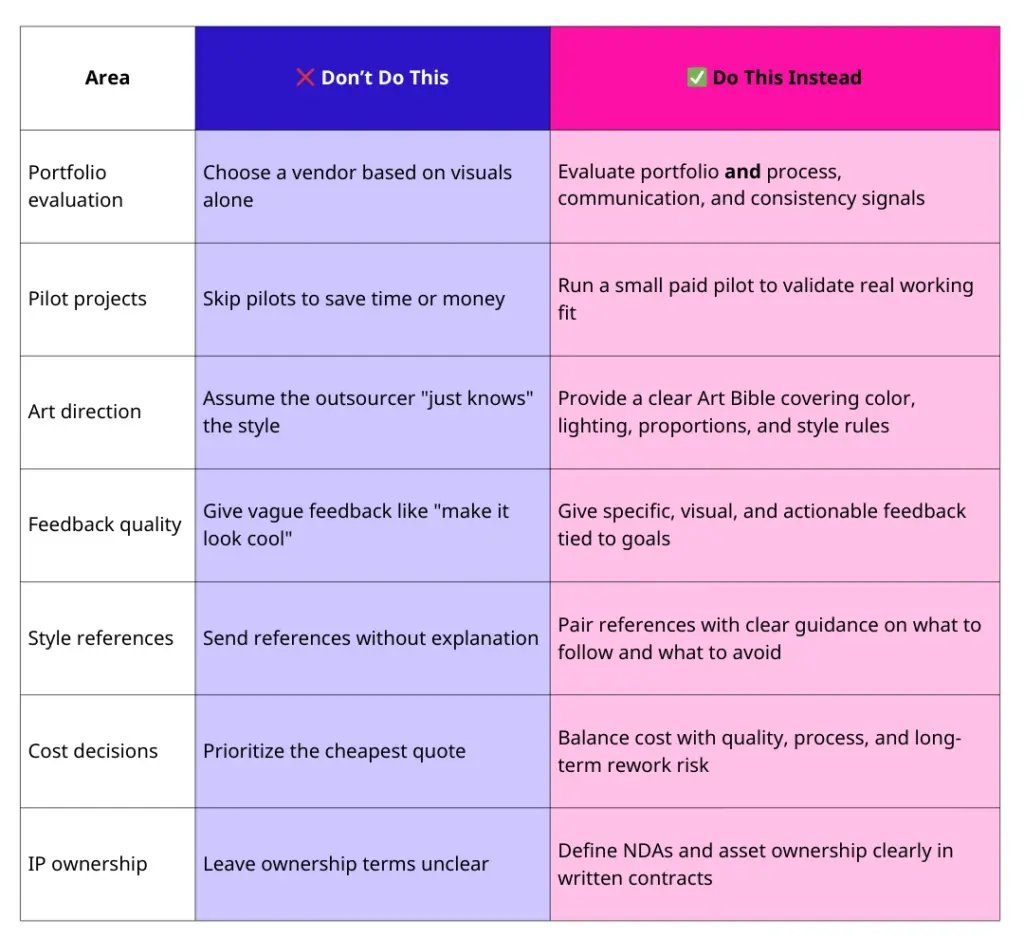
This comparison makes clear that many outsourcing failures originate from setup and decision-making, not from vendor capability alone.
Red Flags vs Green Flags: Vendor Signals at a Glance
The table below contrasts warning signs with positive indicators to help studios quickly assess whether a 2D game art outsourcing partner is likely to succeed in long-term collaboration.

This comparison highlights that reliable outsourcing outcomes depend as much on communication and process signals as on visual quality alone.
Final Takeaway
The right 2D game art outsourcing partner reduces uncertainty across production. They do not just deliver assets. They help stabilize pipelines and protect creative intent.
Using a structured decision framework transforms outsourcing from a risk into a strategic advantage.
Final Vendor Selection Checklist
Before committing to a long-term partnership, game studios should be confident that the vendor meets the following priorities:
- Portfolio work aligns with the game’s genre, tone, and production complexity
- Production process is clearly defined, staged, and scalable
- Communication is clear, proactive, and structured from the first interaction
- Revision handling is predictable and aligned with production timelines
- Capacity and availability support sustained production, not just short-term delivery
- A pilot project confirms real-world quality, working rhythm, and reliability
If a vendor meets most of these criteria across portfolio strength, production process, communication quality, and pilot performance, they are likely a strong fit for long-term production.