

When internal art teams reach capacity, outsourcing 2D game art becomes a production necessity rather than a strategic option. Studios face sudden content spikes and parallel projects that hiring cannot solve fast enough, leading many to adopt external development to manage production risks and overhead. The core challenge is no longer talent availability, but building a production system that scales without breaking visual consistency.
In mobile game studios, multiple titles often progress in parallel, pushing internal teams to their limits. Outsourcing becomes a way to protect focus on core projects while sustaining continuous asset output under growing resource constraints.
Deadlines and funding pressure further accelerate this shift. Tight schedules favor partners built for throughput, while early-stage studios rely on outsourcing to access experienced talent without long-term overhead. Southeast Asia has emerged as a major hub, combining scale, experience, and cost efficiency.
Thunder Cloud Studio operates within this production reality. Rather than functioning as a traditional 2D art vendor, Thunder Cloud delivers a production-oriented 2D illustration system built to generate large volumes of gameplay-ready assets with stable style control. Its 2D game art outsourcing services are structured around three pillars: production-ready assets, scalable pipelines, and long-term style consistency, enabling high-volume delivery without sacrificing visual stability.
This article reflects how Thunder Cloud Studio delivers 2D Game Art outsourcing service as a production system designed for real-time games and long-term scale.
Understanding 2D Game Art
Scope of Thunder Cloud’s 2D Game Illustration Services
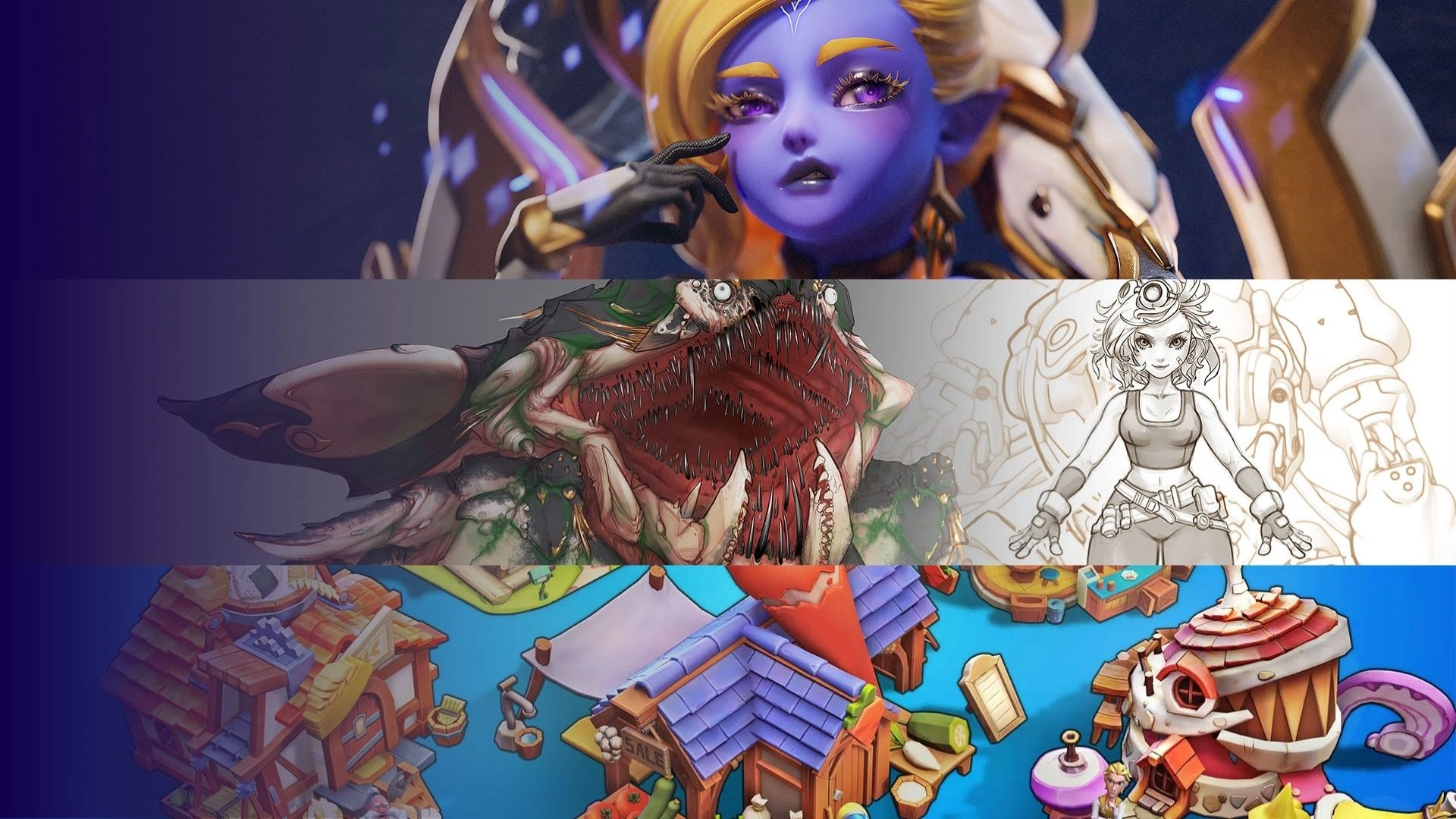
Thunder Cloud Studio focuses on delivering production-ready 2D assets for real game development rather than standalone illustrations.
The scope of Thunder Cloud’s 2D game art outsourcing services includes:
- In-game characters, props, and environments used directly in gameplay
- Backgrounds and level visuals built for large-volume production
- UI and HUD assets designed for integration into live game systems
- Marketing art and key visuals aligned strictly with in-game styles
Across all categories, Thunder Cloud’s core service is not illustration itself, but the ability to produce scalable, engine-ready 2D assets that remain visually consistent across large production volumes. All outputs are delivered as engine-compatible assets designed to integrate smoothly into client pipelines. The service prioritizes gameplay readiness, pipeline scalability, and long-term style consistency over one-off visuals.
The Quality Tiers
At Thunder Cloud Studio, quality tiers are defined based on production function rather than visual style alone. They act as control mechanisms that protect production readiness, scalability, and style consistency.
Not all 2D game art services or 2D game assets serve the same production role. Misjudging this difference creates friction when studios evaluate internal versus external resources. Clear tier alignment keeps large-volume pipelines stable and predictable.
Within Thunder Cloud Studio’s 2D game art outsourcing services, quality tiers are applied as follows:
Casual-level work (commonly for low-mid budget mobile games):
– Simple props, UI elements, icons, and low-complexity 2D game assets
– Designed for high asset volume and fast delivery
– Readability, consistency, and throughput take priority over surface detail
Mid-tier work (often for mid core Mobile or PC/console games):
– Characters, environments, and background visuals
– Stronger structure, silhouette control, and style consistency
– Balanced fidelity suitable for scalable production
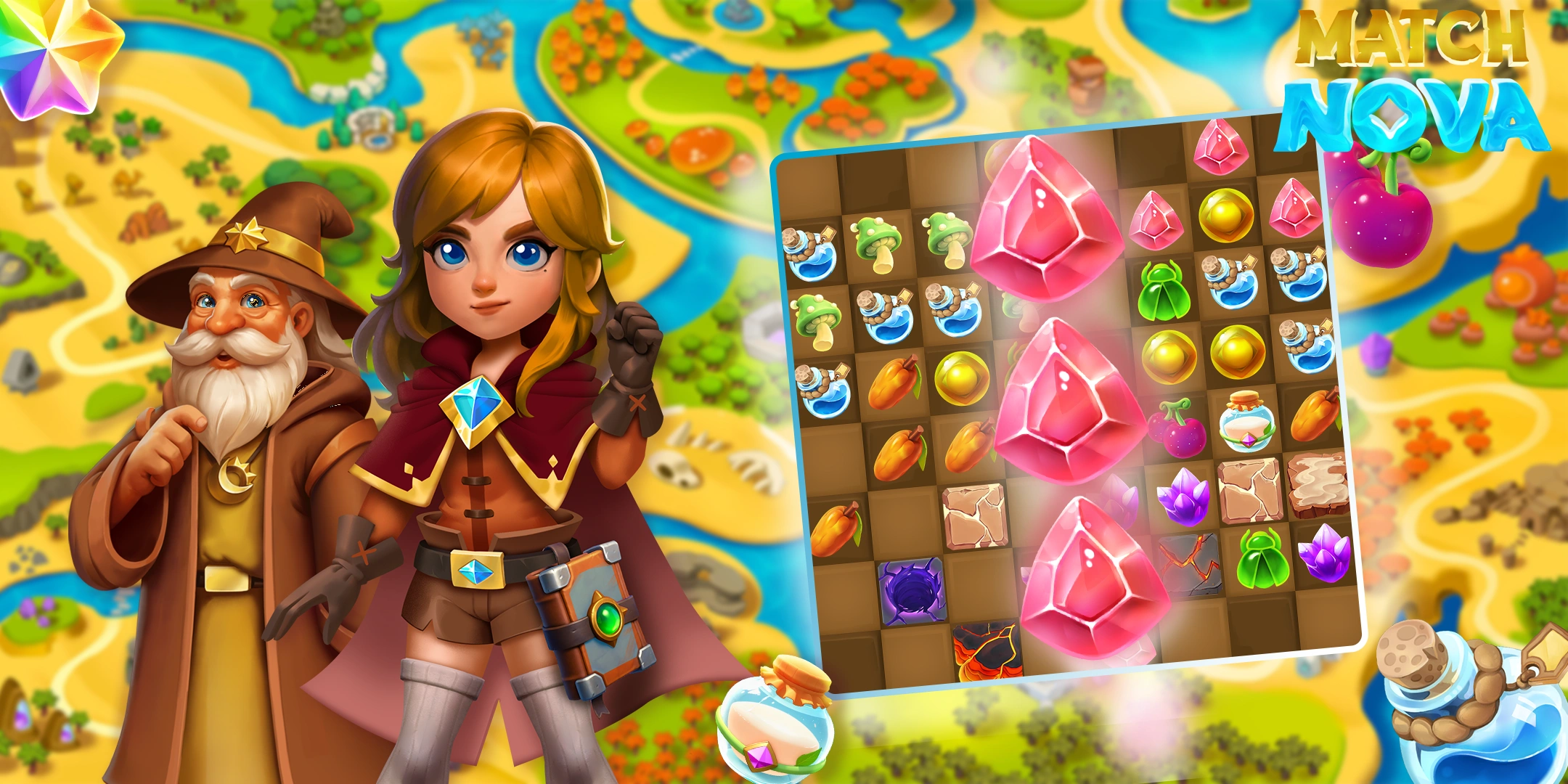
See example: Thunder Cloud Studio’s work on full cycle 2D Game art for Nova Match

Premium work (high end Mobile or PC/console-focused gameplay assets):
– Gameplay-critical characters and environments
– Higher fidelity while remaining engine-ready
– Tighter control over execution, review, and visual impact
Correctly assigning tiers is essential for successful 2D game art services at scale, allowing teams to increase volume without sacrificing consistency or delivery speed.
Production-grade 2D Game Art Workflow for high-volume projects: From brief to final assets
A mature 2D game art outsourcing pipeline is not built around individual illustrations.
It is engineered around consistency, scalability, and controlled execution.
At Thunder Cloud, production is structured to ensure that:
-
The final output fully aligns with the client’s artistic vision
-
Quality and style remain stable across large asset volumes
-
Mass production efficiency does not compromise visual integrity
The workflow is designed to protect direction, prevent style drift, and maintain predictable delivery across the entire lifecycle of 2D game assets.
| Stage | Primary Objective | Execution Focus | Key Deliverables | Production Control & Risk Management |
| Stage 1: Visual Exploration | Validate Art Direction and Style before scaling production. Ensure alignment with narrative, gameplay, platform, and audience. |
|
|
Multiple revision rounds expected. Fast iteration required. Visual parameters are locked only after structural alignment to prevent downstream reinterpretation. |
| Stage 2: Concept Refinement | Translate approved direction into structured, scalable visual systems. Ensure alignment fidelity with locked vision. |
|
|
Prevent style drift across multiple artists. Convert illustrations into repeatable production frameworks to support mass asset creation. |
| Stage 3: Asset Production & Integration | Deliver production-ready 2D game assets aligned with client vision while maintaining consistency and efficiency. |
|
|
Controlled execution at scale. Prevent quality deviation, integration delays, and costly rework. Ensure technical reliability for engine deployment. |
This structured approach enables parallel production across multiple artists while maintaining visual consistency. This is a critical factor in professional 2D game art outsourcing services.
Quality Assurance system for large-scale 2D art outsourcing
Quality assurance is not a separate phase, but a structural component of its scalable 2D production system. QA exists to protect production-ready output, maintain style consistency, and keep large pipelines moving without disruption as asset volume increases.
Within Thunder Cloud’s 2D game art outsourcing services, a strict multi-layer QA system operates, refined continuously over more than 13 years of production experience. Senior and lead artists with long-term project backgrounds monitor this system closely. Nothing leaves the internal pipeline without a full review.
Quality checks begin with self-QA at the artist level. Reviews then progress through supervisors, team leads, and senior reviewers. Each layer validates visual accuracy, technical compliance, and consistency against the agreed benchmark.
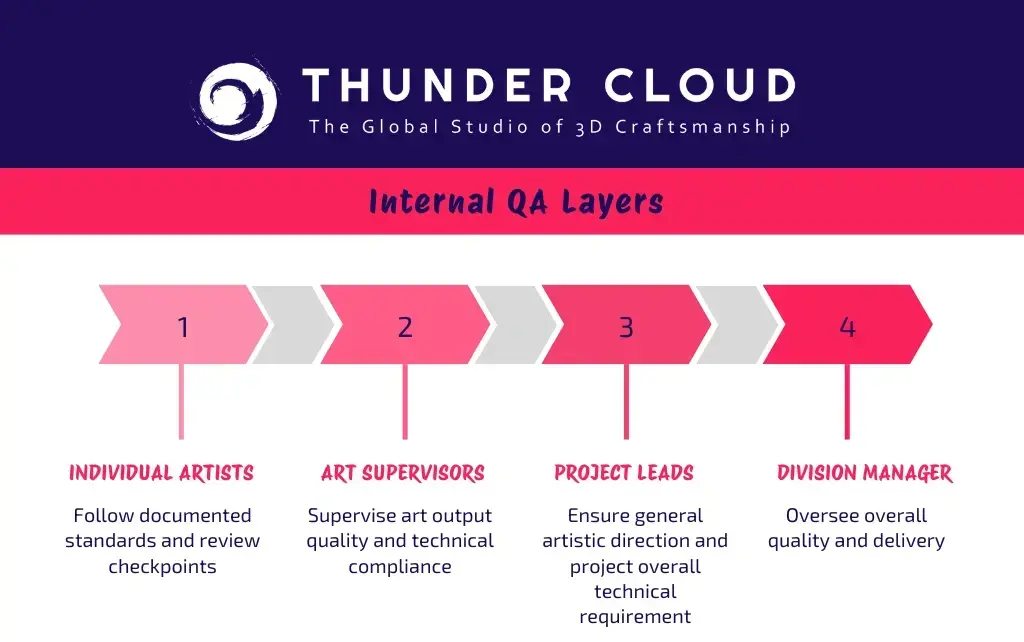
Thunder Cloud Studio internal QA layers
This structured QA approach is designed specifically for high-volume pipelines. It reduces unnecessary feedback rounds.
By aligning closely with client style references and technical requirements early, output matches expectations across large production batches. The QA structure supports batch production rather than one-off assets, even when multiple artists work in parallel.
The QA system is designed to remain non-destructive. Clean file structures, layered workflows, and documented checkpoints allow smooth collaboration across teams. Assets remain easy to hand over, revise, or extend, enabling clients to continue development internally without friction.
Team Structure Required for Reliable 2D Game Art Outsourcing
In scalable 2D game art outsourcing, team structure determines whether scale brings clarity or chaos. Instead of operating as isolated artists, a professional outsourcing studio functions as a layered production system with clearly defined responsibilities.
Core production roles:
- Artist level: Responsible for executing assets based on established style guides, technical constraints, and production benchmarks. Focus on consistency and individual asset quality.
- Supervisor level: Ensures alignment between asset output and defined visual direction across multiple artists and asset categories, following art direction brief and project requirement
- Team lead level: Maintain quality and art direction consistency and synchronizes timelines and feedback cycles across production streams.
- Art direction / division level: Define art direction and quality standard, maintains long-term visual coherence and strategic alignment between art direction and project goals across development phases.
Operational and collaboration roles:
- Project coordination: Translates creative and technical requirements into production tasks, tracks deliverables, and maintains communication flow between internal teams and outsourcing partners.
- Cross-time zone collaboration layer: Structures communication pathways and decision boundaries to ensure smooth integration regardless of geographic distance.
This structure reduces risks in large-volume production, including style drift, communication breakdowns, scope creep, and inefficient revisions. With the right structure, 2D game asset production through outsourcing scales reliably while preserving visual stability.
Cost Drivers in Production-ready 2D Game Art Outsourcing
From Thunder Cloud Studio’s experience delivering high-volume 2D game art outsourcing services, cost issues rarely come from rates alone.
They appear when production readiness, pipeline scalability, or style control break down. Unclear scope, quality tiers, or workflows drive rework and inflate cost.
In Thunder Cloud’s 2D game art services, cost follows scope clarity, quality tier, and production stage. Exploration work and production-ready delivery require very different effort levels.
A practical way to frame pricing is Cost = Complexity × Clarity × Workflow Maturity. Weak clarity or immature workflows increase cost faster than rate differences. See more details in the 2D game art cost breakdown article.
Cost predictability depends on understanding the trade-off between detail and production speed at each quality tier. Higher fidelity increases iteration time, while faster delivery limits surface polish. The same dynamic applies to cost versus quality, where structure and clarity influence outcomes more than raw rates.
Geography shapes baseline cost expectations but does not determine quality. Studios in North America and Western Europe usually command the highest rates due to labor costs. Eastern Europe sits in the mid-range.
Latin America and parts of East Asia are often chosen for style fit or time-zone alignment. Southeast Asia has emerged as a major hub for the game market, especially for art outsourcing services due to mature talent pools and scalable studio infrastructure. The real variable remains workflow structure, communication, and QA maturity.
A Practical Decision Framework for 2D Game Art Outsourcing
Thunder Cloud Studio approaches outsourcing decisions through the lens of production risk management. The focus remains on whether production-ready assets, scalable pipelines, and consistent style can be sustained under real volume pressure. The framework below reflects common inflection points observed across real game production cycles.
Outsource 2D game art when:
- Asset volume exceeds internal capacity or deadlines compress beyond what hiring can solve in time.
- Revision bottlenecks slow production more than quality issues.
- Multiple projects compete for the same internal team and priorities begin to overlap.
Keep work in-house when:
- Production is in early exploration phases.
- Visual styles change rapidly and require daily creative iteration.
- Core identity decisions need direct internal ownership.
Adopt a hybrid model when:
- Production stabilizes and pipelines mature.
- Asset throughput becomes the main constraint rather than creative direction.
Fast scaling only works when direction stays stable; otherwise, volume amplifies inconsistency. In this model, art direction remains internal, while execution-heavy asset production scales externally. The balance preserves creative control while increasing delivery speed.
For a detailed breakdown of when each approach works best, including timeline and budget considerations, see in-house vs outsource for 2D game art production.
Choosing a long-term 2D Game Art Partner
Once the decision to outsource is clear, selecting the right partner becomes critical. Evaluation should focus less on isolated visuals and more on how well the studio operates within real production conditions.
Key evaluation criteria include:
- Pipeline transparency: clear visibility into workflow stages, review checkpoints, and delivery expectations.
- Style adaptability: the ability to match and maintain a defined art direction across different asset types and volumes.
- QA methodology: a documented, multi-layer quality assurance process applied consistently throughout production.
- Production scalability: proven capacity to handle large asset batches without quality degradation.
- Communication structure: predictable feedback loops, approval flow, and response timing that reduce workflow friction.
Portfolio relevance also matters. Past work should reflect comparable scopes, quality tiers, and production demands rather than standalone showcase pieces.
Making Outsourcing Work in Practice
Effective outsourcing starts with a small test rather than full commitment. Early collaboration should demonstrate how a partner interprets briefs, translates feedback, and manages timelines under realistic conditions.
To get the best results from outsourcing:
- Share clear style references and benchmarks upfront to reduce interpretation gaps.
- Define quality tiers and asset priorities early to avoid mismatched expectations.
- Consolidate feedback into structured review rounds rather than fragmented comments.
- Lock visual direction before scaling volume to prevent revision loops.
Strong signals include clear questions raised early, clean and decision-ready first drafts, accurate style matching, and visible scalability in team setup. These indicators reveal how the partner will perform once production pressure increases and asset volume grows.
This approach works best for studios with a defined style direction and ongoing production needs. Teams still exploring visual identity may benefit more from internal iteration before scaling externally.
Closing Perspective: Choosing the Right 2D Game Art Outsourcing Partner
Thunder Cloud Studio delivers 2D game art outsourcing as a scalable production system, not a task-based service. The focus remains on production-ready assets, pipeline scalability, and long-term style consistency.
When systems are structured correctly, outsourcing absorbs pressure instead of creating risk. Studios scale faster, stay consistent, and keep creative direction intact.
Explore Thunder Cloud’s 2D illustration services and see how scalable pipelines and production-ready assets are built in real game production.