

Game trailers are one of the most important marketing assets in a game’s launch pipeline, which is why game trailer outsourcing has become increasingly common. Large publishers often need multiple trailers around major conferences, seasonal campaigns, or live game updates, while studios that only need trailers occasionally may find it more cost-efficient to outsource than maintain a fixed in-house trailer team.
When game studios outsource trailer production, they usually look for a game cinematic studio with proven experience, a mature workflow, clear approval structure, and strong client involvement throughout the project. The goal is not only to create visually strong cinematics, but to deliver a trailer that clearly communicates the game’s message and supports the wider marketing campaign.
This article breaks down how Thunder Cloud Studio approaches video game trailer production end to end: how the pipeline is structured, how client collaboration works, what a quotation should include, and what game studios should look for in a cinematic outsourcing partner. More importantly, it shows what clients gain by outsourcing to Thunder Cloud Studio: high-quality trailers built to keep viewers engaged, a stronger balance between visual quality and production budget, and a mature workflow that keeps quality, feedback, and schedule under control from brief to final delivery. Studios ready to explore a collaboration can review the 3D CGI cinematic trailer service directly.
What “Full-Pipeline” Actually Means in Game Cinematic Production
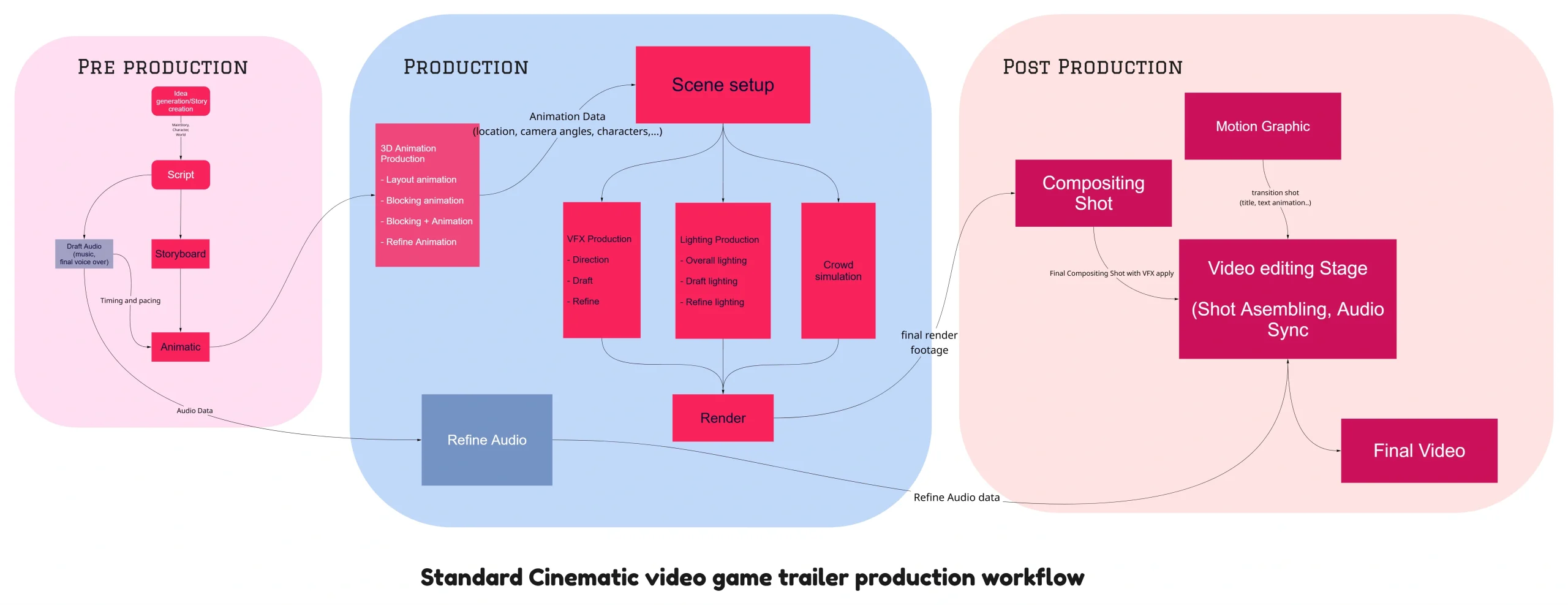
Full-pipeline cinematic production means one studio owns every phase: pre-production, CGI cinematic production, and final post-production. No phase is handed off to a separate vendor. Visual quality and creative intent stay consistent from the first storyboard frame through the final color grade.
Thunder Cloud Studio’s production scope covers all of the following in-house:
- Art direction from creative and concept idea
- Pre-production: storyboard sketches, animatic layout, cinematography layout
- CGI cinematic production: refine, look development 3D in-game asset to cinematic level, 3D animation, scene setup with VFX, lighting and crowd simulation
- Post-production: Compositing and video editing with music/SFX
The engagement model is flexible. Some studios need full pipeline ownership from concept to delivery. Others have internal capabilities at specific stages and need a partner to cover the remaining phases. The studio structures each engagement around what the game studio actually needs, not a fixed service package.
This flexibility matters most for outsourcing managers and producers at AA/AAA studios who need a partner that matches internal production standards, not a vendor that delivers assets and steps away.
What a Quotation From Game Cinematic Studios Usually Includes
One of the most common questions from producers approaching a cinematic outsourcing partner is what a CGI game trailer quote actually covers. Aside from the dollars, a standard quotation usually includes:
- Scope of work: every production phase covered, from storyboard and animatic through post-production
- Asset breakdown by stage: each asset such as hero characters, support characters, props, and environments is listed by its production stage, such as lookdev, rigging, assembly, or shot support
- Shot complexity classification: each shot is grouped into simple, medium, or complex based on production difficulty and creative demand
- Pricing structure by scope component: pricing is broken down in a way that helps clients understand what drives budget across assets, shots, and production stages
- Total scope summary: the full production scope expressed in one clear commercial view for evaluation and comparison
Cost is typically driven by shot complexity, asset reuse, and revision depth rather than duration alone.
How cinematic shot complexity is classified in outsourcing
Cinematic production studios do not classify shot complexity by instinct alone. Complexity is assessed through practical production factors that affect planning, team allocation, review flow, and execution risk.
| Shot level | Production profile | Typical evaluation criteria |
| Simple shot | Controlled and easy to manage. | Static or light camera move; simple framing; limited character action; 1–2 characters; supporting VFX only; general lighting. |
| Medium shot | One or two more demanding elements. | More dynamic camera; clearer action; more interaction; visible VFX support; more cinematic lighting. |
| Complex shot | Multiple demanding elements in one shot. | Dynamic camera tied to action; complex performance or combat; multiple active characters; rich VFX; advanced lighting; crowd or battle setup. |
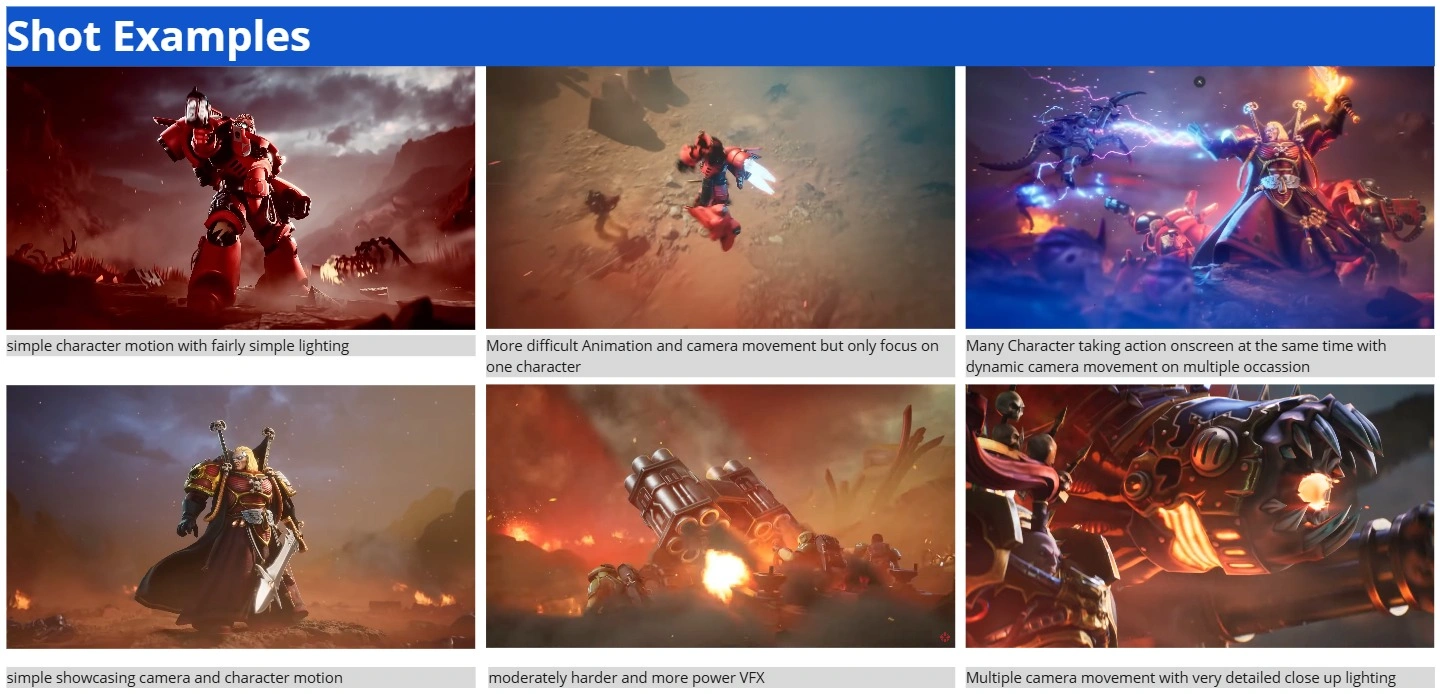
In conclusion, shot complexity is rarely defined by only one factor. The combination of camera behavior, character action, VFX demand, lighting requirement, interaction density, and scene scale is evaluated before assigning a classification. This helps clients understand why some shots require more production control than others, even when the final screen time looks similar.
This level of detail means a senior producer or outsourcing manager can review the quote and understand exactly what is included, what is excluded, and what factors are likely to affect scope if the brief evolves.
The Team Structure Behind a Cinematic Trailer Project
The first deliverable Thunder Cloud Studio produces is a detailed production strategy proposal. This document outlines the creative approach, pipeline structure, phase milestones, and review gates specific to that project. After that, quotation follows the plan, not the other way around.
The Art Director gives general artistic direction per project. A Project Manager supervises the overall project timeline, delivery schedule with the assistance of an assigned coordinator for the production team’s day-to-day management. Creative and technical control sit with the Project Lead from brief intake through final delivery. The whole team engages in weekly meetings to control over schedule and project quality so that directorial perspective stays consistent across every phase.
Production runs through three formal review gates:
- Blockout: structural timing, camera, and blocking are approved before any asset refinement begins
- Draft: animation quality, lighting direction, and VFX are locked with client sign-off
- Refine: final polish, facial detail, render quality, and audio are reviewed before delivery
Each gate requires client approval before the next phase starts. This keeps feedback structured, changes manageable, and quality controlled at every stage rather than only at the end.
How Game Studios Work With Thunder Cloud During Production
Every project has a dedicated client-facing team:
- A Project Manager supported by a project coordinator: Primary point of contact for scheduling, deliverables, and day-to-day communication
- A Project Lead working directly with the involving teams such as modeling team, engine and animation team: Oversees pipeline sequencing, team allocation, production management, and milestone delivery
- An Art director or Head of Production: Owns visual consistency and translates the client’s creative brief into production decisions
Clients can engage at any stage of production. Feedback rounds are not capped. Revisions are unlimited within the agreed scope of work. The milestone structure ensures feedback arrives at the right moment in the pipeline, when changes are still efficient to implement.
In real production, schedule pressure rarely comes from the rendering stage alone. It usually comes from delayed approvals, fragmented feedback, or structural changes introduced after the project has already moved downstream. Even when revision rounds are not formally capped, keeping most milestone feedback within two to three focused rounds is usually the most effective way to protect schedule and avoid avoidable scope growth.
Asset swaps, creative direction changes, duration changes, and increases in shot complexity can all create rework that spreads across animation, lighting, VFX, and editorial. The cinematic studio therefore treats blocking as a major control point. Once location, pacing, and animation direction are locked carefully at this stage, the rest of the pipeline can move forward with far greater stability.
How Thunder Cloud Keeps Trailer Production Efficient Under Real Production Pressure
In cinematic production, efficiency does not come from rushing later stages. It comes from locking the right decisions early, collecting usable feedback in enough detail, and reducing avoidable rework once multiple departments are already moving in parallel.
When deadlines are tight and client involvement is high, the team works to gather feedback as early and as completely as possible at each approval point. More detailed feedback at the right stage allows the team to move forward with stronger alignment, instead of carrying uncertainty into later phases where revisions become more expensive.
In some cases, production also benefits from pushing selected shots beyond draft quality before all feedback is fully closed. Rather than repeatedly reworking a draft-stage version, the team may push selected shots closer to final quality before all notes are closed. In real production, this can be a more efficient way to converge on quality, especially when pacing, lighting, and performance need to be judged together rather than in isolation.
This approach works best when two conditions are true: the deadline is compressed, and the client is highly engaged throughout production. It is not a replacement for review structure, but a controlled way to keep progress moving when conventional stage-by-stage iteration would slow the schedule down.
Across a series of trailers, reusable assets become even more important. Characters, rigs, shaders, environment components, and established lookdev decisions can all carry forward from one trailer to the next. This not only shortens production time, but also helps maintain visual consistency across live ops campaigns, seasonal updates, and franchise-based marketing beats.
The Video Game Trailer Production Pipeline
A strong CGI game trailer pipeline is not just a list of technical steps. For game studios, the real question is whether each stage has clear control points, clear deliverables, and clear approval timing. At Thunder Cloud Studio, the pipeline is structured to lock the right decisions at the right time, so quality stays stable and revisions stay controlled. A standard cinematic trailer runs approximately two months from pre-production kick-off through post-production delivery. Here is how that time breaks down.
1. Pre-production: setting the visual direction
Pre-production establishes every visual and editorial decision the rest of the pipeline depends on with the following stages:
- Storyboard and animatic (motion and timing reference, no final audio)
- Layout passes and 3D motion blocking
- Editorial (rough editorial assembly showing pacing before assets are finalized)
- Color style keyframe (the lighting and tone reference for all subsequent phases)
- 2D environment concept (the spatial and visual reference for environment production)
This stage focuses on the story line, narrative flow, determines the overall concept direction, establishes the guideline for artistic direction – style, color, composition, music mood and tone.
2. 3D Asset Production: assets, lookdev, and world assembly
The production phase covers asset refinement, lookdev, rigging, environment lookdev, and full scene assembly. Three teams run in parallel:
- 3D modeling team – asset refinement/polish when the models provided are in-game assets to match the trailer visual quality
- Animation team – character and creature animation supervised by an animation lead
- Cinematic team – character, environment look development, VFX, environment assembly, lighting support, and render prep supervised by a technical lead
Running parallel teams requires tight sequencing. The modeling team’s output feeds directly into the animation team’s rigs. The cinematic team builds the environment that animators are blocking into. The production lead manages that sequencing actively throughout this phase.
3. 3D CGI production: animation, VFX, and render
This phase runs the full animation pass from blocking through final polish, alongside VFX, crowd simulation, lighting, and render. Lighting and VFX are matched against the color key approved in pre-production. Any shot that drifts from the approved color key is corrected before render, not flagged in post. That discipline is what maintains visual consistency across a trailer spanning dozens of shots.
4. Post-production: editorial and final delivery
Post-production covers compositing, final editing, color grading, and audio. The default audio package includes clients’ composed music, or copyrighted stock SFX, music, and generic voice-over. This provides a functional, complete audio layer without requiring a full original score commission at this stage.
The total window for a standard cinematic trailer is approximately two months. Projects with higher shot count, complex crowd VFX, or multi-character fight choreography carry longer schedules. The production strategy proposal scopes the timeline to the actual brief rather than an assumed average.
Structured QA Layers for Cinematic Production
A cinematic trailer is judged as a complete marketing asset, not as a collection of individual shots. That is why Thunder Cloud Studio runs quality control through multiple QA layers across the pipeline rather than leaving quality checks to the final render stage.
QA layers are built to catch problems at the right stage, before they become expensive to fix later. Every artist working on cinematic production is required to follow QA documents strictly before handoff. Each stage must meet the defined objectives and key results set for both artistic quality and technical performance. In addition to the studio’s standard QA framework, individual projects may also have tailored QA documents based on specific creative, technical, or client-side requirements. These QA checkpoints are reviewed carefully throughout the pipeline in a non-destructive way to maintain quality control while preserving the best possible production performance.
For game studios, layered QA means fewer late-stage surprises and more reliable delivery control.
- Problems are caught earlier, when they are still efficient to correct and avoid out of scope
- Feedback stays tied to the right milestone instead of becoming a last-minute revision pile
- Visual quality remains consistent from shot to shot and from phase to phase
- The final trailer holds together as one coherent campaign asset, not just a series of good-looking scenes
This is one of the clearest differences between a mature production partner and a reactive vendor. A stronger QA structure protects schedule, stabilises quality, and helps clients outsource trailer production with more confidence.
What Working With Thunder Cloud Looks Like in Practice
Thunder Cloud’s longest active relationship is this partnership with Modern Times Group. Under this arrangement, the team handles all cinematic trailer production across MTG’s portfolio: InnoGames, Snowprint Studios, Hutch, and Ninja Kiwi. The studio operates as an embedded production partner, long-term via contract.
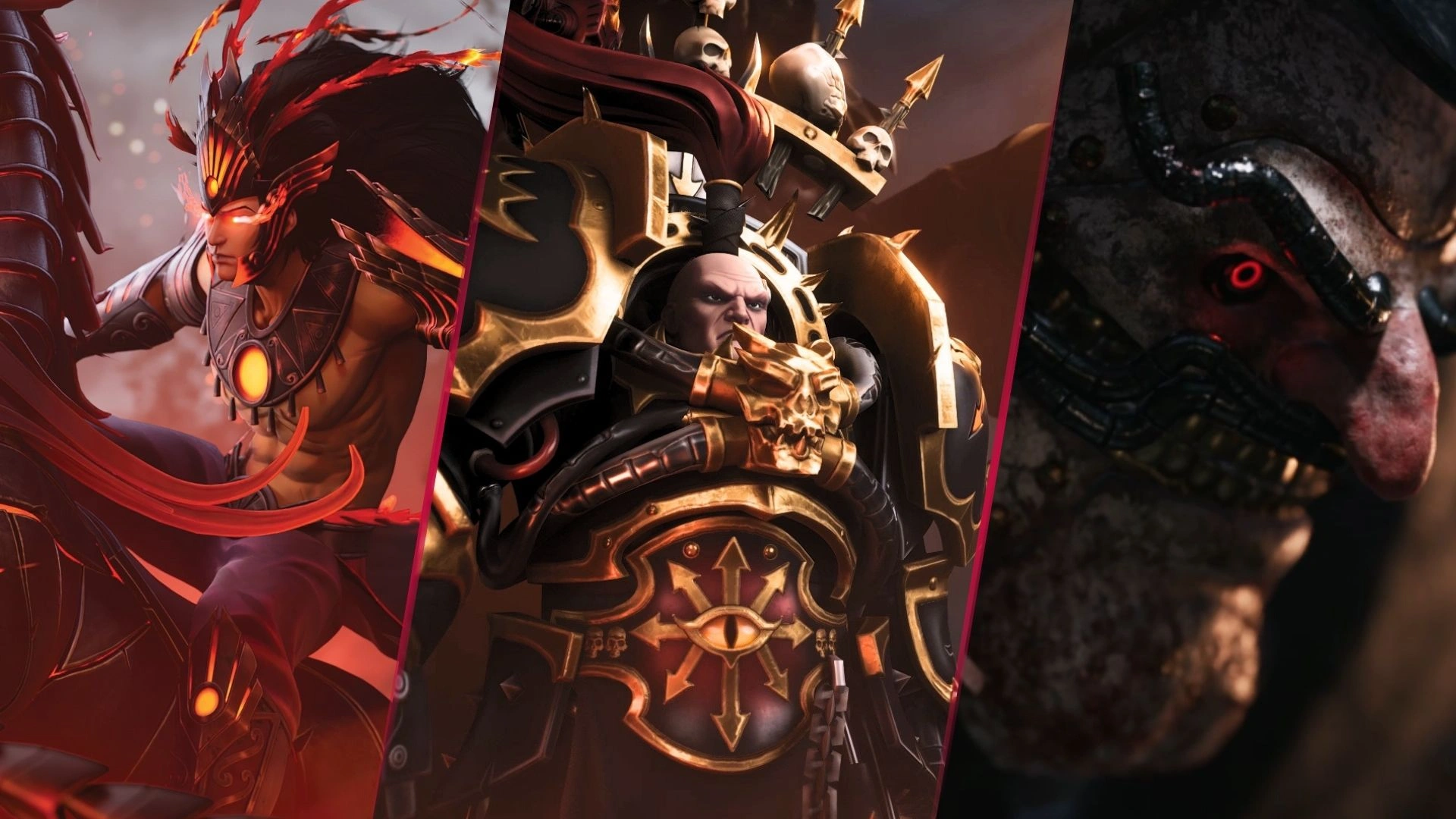
A concrete result from that partnership: the Warhammer 40K: Tacticus – The Space Hulk Events Trailer, produced for Snowprint Studios, reached 4.2 million views within four weeks of release. Explore the ongoing collaboration of Thunder Cloud Studio and Snowprint Studios in the Warhammer 40K: Tacticus game trailer series.
The contract-based model works because Thunder Cloud Studio carries institutional knowledge of each studio’s art direction, quality standards, and review process. Each new trailer is not a cold start. The team understands the franchise, the audience, and the production rhythm the client expects. Studios looking to understand how to select a cinematic outsourcing studio can read the article on how game studios evaluate a cinematic studio.

Thunder Cloud has been a reliable and professional partner, always responsive, consistent and delivering high-quality work. Personally, I appreciate their attention to detail and dedication, which is why we at MTG look forward to working with them for the long run.
Cinematic Trailers vs. Gameplay Trailers: Knowing Which to Commission
The choice between a cinematic trailer and a gameplay trailer depends on what the trailer needs to do. Both formats serve different moments in a game’s marketing lifecycle.
CGI cinematic trailers are the stronger choice when:
- The goal is to establish world, tone, or characters before audiences have seen gameplay
- The release is a franchise announcement or story reveal
- Emotional engagement and brand authority are the primary objectives
- The game’s visual identity needs to be defined before live gameplay footage is ready
Gameplay trailers are the stronger choice when the product itself is the sell. When mechanics, systems, or the visual style of the game in motion will convert an audience, gameplay footage outperforms cinematic production. A full comparison is in the article on cinematic trailers vs. gameplay trailers.
What to Look for in a Game Cinematic Outsourcing Partner
The distinction between a production partner and a vendor shows up when something needs to be resolved quickly. A vendor executes a brief. A partner anticipates problems, flags risks before they become delays, and brings creative judgment to decisions that go beyond the technical.
When evaluating game cinematic studios, outsourcing managers should examine the following:
- Clear decision locking across stages
Storyboard, layout, and especially blocking should act as control points. If structural decisions are not locked early, changes later in production will affect animation, lighting, VFX, and editorial at the same time. - Visible progress throughout the pipeline
Strong partners provide consistent intermediate outputs such as animatic, layout, blocking, and draft. This keeps alignment continuous and prevents long gaps where work cannot be reviewed. - Ability to handle feedback without destabilizing production
Delayed or unclear feedback, as well as late-stage changes in assets, duration, or direction, are common in real projects. A reliable partner helps contain these changes early and avoids pushing instability into later stages. - Quotation that reflects real production structure
A useful quote breaks down assets, shot complexity, and production stages. This makes it easier to adjust scope when needed, instead of renegotiating based on a single total number.
A studio that agrees to an impossible schedule without pushback is not accommodating. Stronger pre-production, clearer phase milestones, and honest scoping protect delivery dates far better than optimistic commitments. For a grounding perspective on the full production process, the article on how a game trailer is made covers the fundamentals.