

2D games continue to prove that strong environmental art direction can define a title as clearly as mechanics or narrative. From atmospheric platformers to stylized mobile titles, 2D environment design shapes player perception, gameplay readability, and emotional tone.
Well-known 2D-driven games such as Ori and the Blind Forest, Celeste, Cuphead, and Hollow Knight demonstrate how cohesive environmental systems elevate immersion and brand recognition at a global scale. In each case, environments are not decorative backdrops. They function as structured visual systems that support clarity, pacing, and progression logic.
For studios evaluating 2D environment art services, the key question is not whether backgrounds can look impressive. Instead, producers need to know whether those environments can be delivered production-ready, remain consistent across large asset batches, and scale with the game roadmap without visual fragmentation.
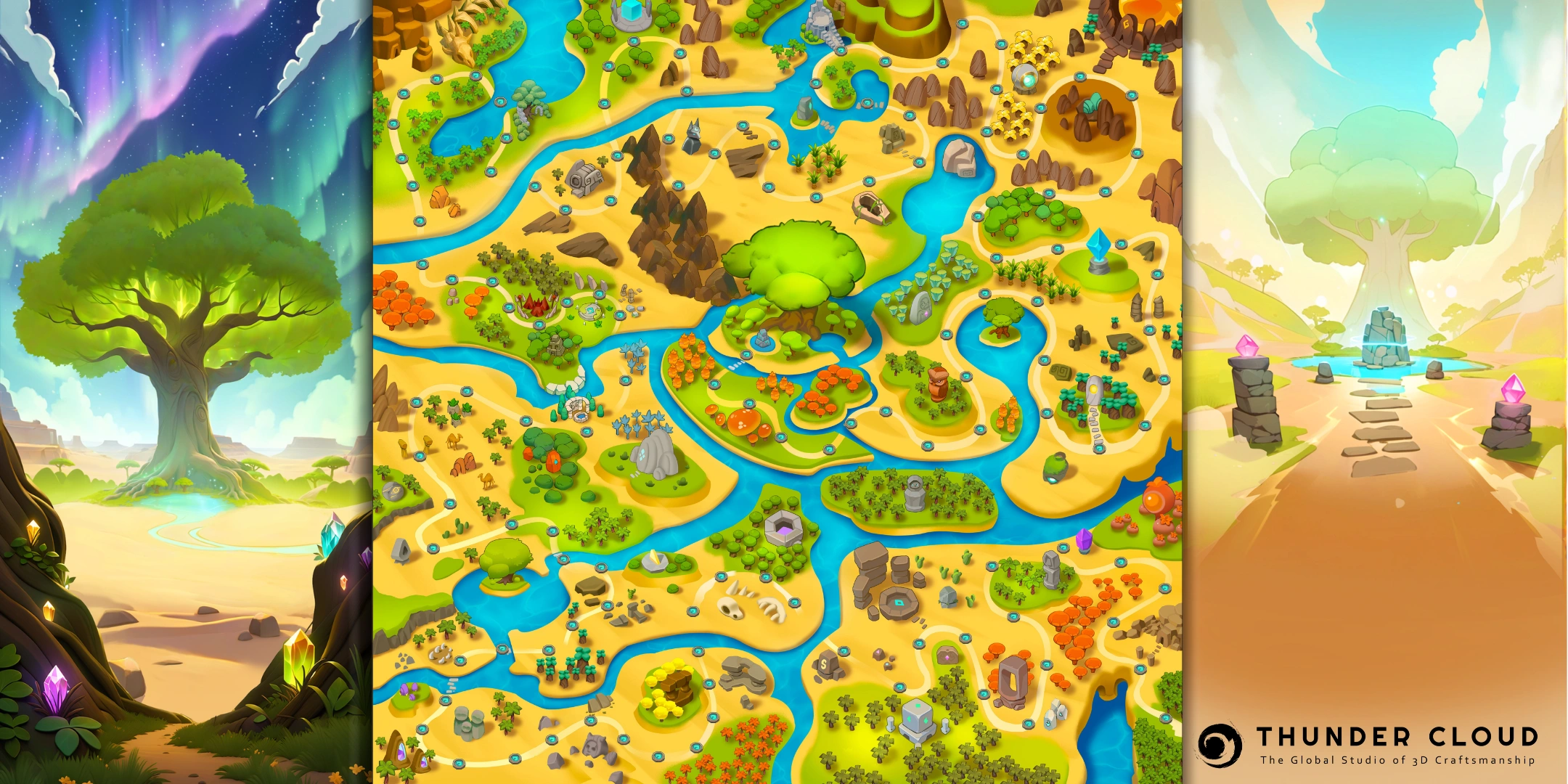
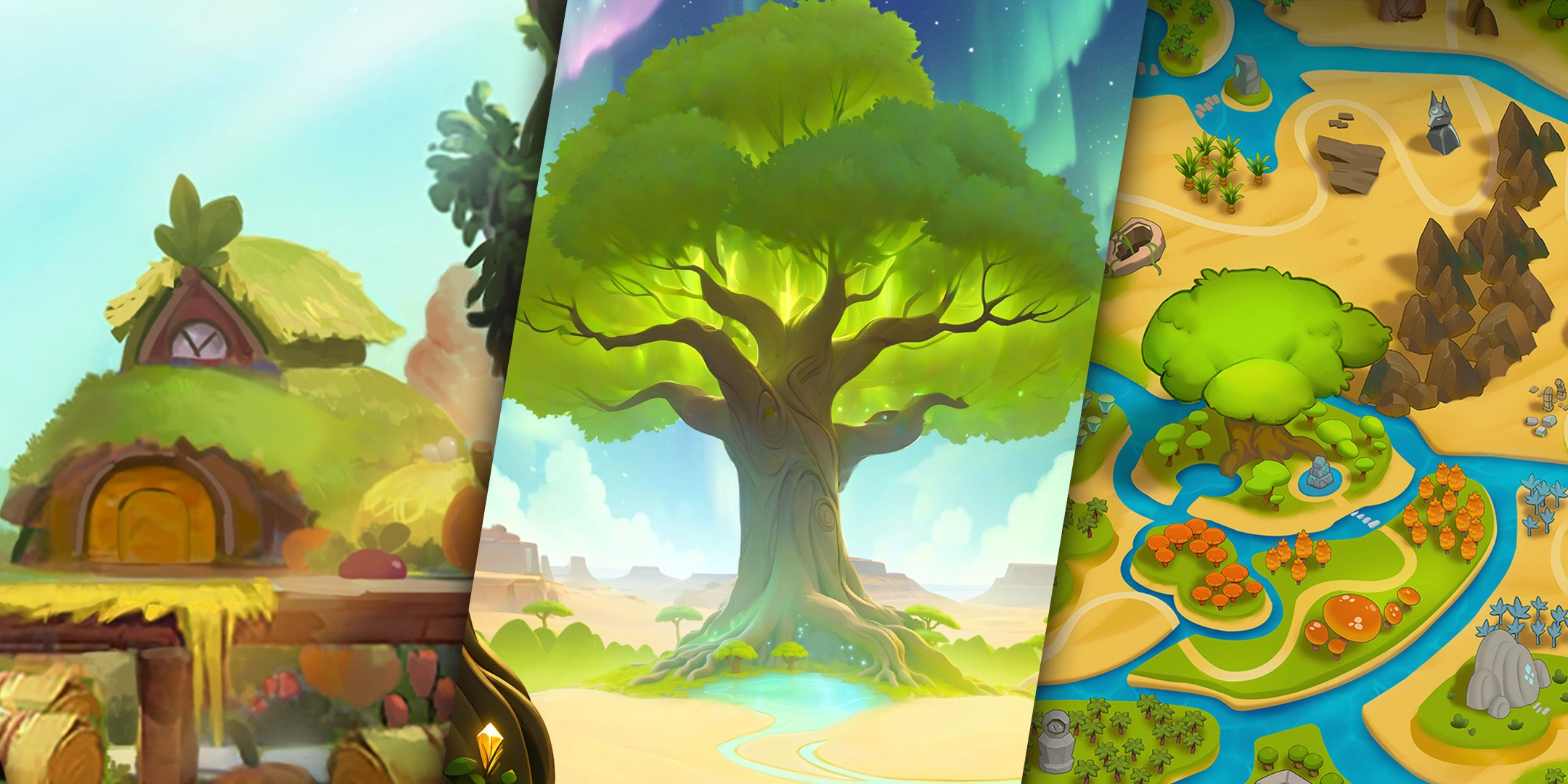
Thunder Cloud Studio’s 2D Environment Design for Nova Match – Match-3 Casual mobile game
What Are 2D Environment Art Services?
2D environment art services refer to the structured production of game-ready background assets, scene compositions, and visual environments designed to support gameplay clarity, immersion, and technical engine requirements. These services typically cover screen backgrounds, world maps, stage environments, modular scenery pieces, and supporting environmental props.
In practical production terms, 2D environment assets include:
- Parallax background layers
- Modular scenery pieces such as trees, buildings, and terrain fragments
- Foliage and environmental props
- Tilesets
- Interactive environmental objects
- Map elements and navigational visuals
However, professional 2D environment art services extend beyond illustration. They incorporate structured file delivery, technical alignment with engine requirements, scalable planning, and multi-layer QA governance. The outcome is not simply a finished image, but an environment system that integrates smoothly into development pipelines.
Core Deliverables in Professional 2D Environment Design
The exact scope depends on client specifications, yet most 2D environment design engagements include gameplay backgrounds, map systems, and modular environmental assets.
Deliverables typically involve:
- Screen backgrounds for gameplay
- World or level map environments
- Modular environmental props
- Scene variations tied to progression or thematic changes
Production-ready delivery focuses on implementation clarity. Files are prepared according to technical requirements, which often include structured PSD files, PNG or JPG exports at defined resolutions, modular separation of elements, and consistent naming conventions. When animation is required, texture atlases and JSON files are validated before handoff.
As a result, assets are organized for efficient engine integration rather than left as flattened illustrations. This distinction separates illustration-only work from structured pipelines typically found in professional 2D game art studios.
Workflow Behind Scalable 2D Environment Art Services
Scalable 2D environment art production operates as a controlled system. It relies on defined stages, complexity governance, and measurable validation checkpoints.
Visual Alignment and Scope Definition
At the start of production, teams align environment scope with narrative intent, supported by clear art direction, visual examples, mood boards, and curated reference boards. These materials define atmosphere, color language, lighting logic, architectural style, and emotional tone before execution begins.
Gameplay readability, platform constraints, and roadmap expansion plans are then evaluated within that artistic framework. This structured art-direction phase prevents stylistic drift, reduces misallocation of time, and ensures that high-impact scenes receive the appropriate visual depth and narrative weight.
Complexity is defined early to anchor estimation logic. For example, in a mid-core mobile game scenario, consider a set of 6 environment pieces: 5 gameplay backgrounds and one world map. The 5 gameplay backgrounds are mobile-sized, layered parallax environments designed for moment-to-moment play. Each includes foreground, midground, and background separation with controlled lighting and readability for smaller screens.
The sixth asset is a layered world map built as a four-scroll “continent” layout. It integrates parallax layers, node icons, progression markers, shader masks, and decorative environmental elements. Within Thunder Cloud Studio’s benchmark, this would align with a “Background – Complex” classification due to its structural layering and system-level function.
Under these conditions, the six-map set may require approximately three days for structured sketch and draft development, followed by three days of refinement per artist at standard to complex tiers. By contrast, a single standard-tier gameplay background without systemic map logic may average half a working day.
Time scales with structural complexity, layering depth, and functional requirements rather than simple asset count.
Structured Visual Tiering
This tiered hierarchy functions as a production control mechanism. It determines detailing depth, lighting treatment, iteration cycles, and review intensity before execution begins.
When teams define tiers clearly, budget allocation follows gameplay impact instead of equal distribution. Hero environments receive deeper refinement, while support layers follow optimized standards. Thunder Cloud Studio applies this tiering system during scope definition, allowing producers to forecast timelines and control revision risk.
Tier clarity also establishes measurable expectations. 2D artists work within predefined fidelity boundaries, which reduces subjective feedback and limits iteration drift. As asset volume increases, this governance preserves lighting logic, detail density, and visual weight across the environment system.
Below is a simplified illustration of structured visual tiering aligned with a Tier A (mid-core) 2D mobile casual benchmark:
- Casual (simple) tiers emphasize efficiency and clarity.
- Mid-level (standard) tiers balance polish and speed.
- Complex tiers require deeper refinement, additional QA intensity, and stronger art direction input.
Asset Structuring and Technical Alignment
2D environments are commonly developed for engines such as Unity or Godot. Teams align deliverables with client technical specifications, including version compatibility and resolution standards.
Thunder Cloud Studio’s asset delivery standards typically include PSD with organized layer hierarchies, consistent naming conventions, modular separation for reuse, engine-ready exports, and validated atlas exports when animation is involved. Animated elements are tested before delivery and accompanied by preview outputs for verification.
Through this structured approach, 2D environment art services ensure assets are implementation-ready rather than visually complete but technically fragmented.
Multi-Layer QA Pipeline
instead of a single-pass review. As asset counts increase, minor inconsistencies in lighting, scale, or texture density compound quickly and create visible fragmentation.
A typical governance structure includes assigned individual artist review, lead artist supervision, project lead validation, and division-level oversight. Each layer performs a distinct function. The artist ensures execution accuracy. The lead protects stylistic cohesion. The project lead verifies scope alignment. Division oversight safeguards cross-project standards.
For highly complex tiers, a final art director pass may refine nuance and reinforce emotional tone at critical milestones.
This layered QA model forms the core of Thunder Cloud Studio’s internal QA pipeline. It transforms feedback from reactive correction into proactive governance, ensuring that environment systems scale without losing coherence or identity.
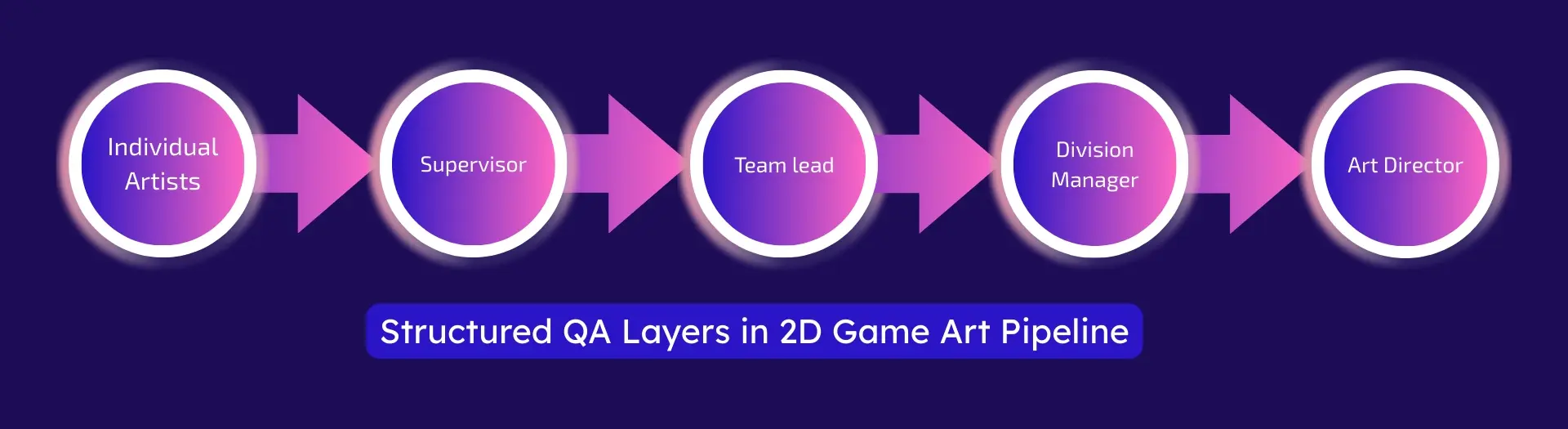
Thunder Cloud Studio's structured QA layers in 2D game art pipeline
Build In-House or Leverage 2D Game Art Outsourcing?
Studios evaluate in-house production versus 2D game art outsourcing based on roadmap stability, bandwidth, and scalability needs.
In-house teams perform effectively when art direction remains stable and capacity is secured long term. However, outsourcing becomes strategically valuable during art revamps, rapid content expansion, prototype validation, or peak production periods.
For example, games undergoing visual revamps or studios developing early-stage prototypes often engage structured 2D environment art services to accelerate production without long-term overhead. In such contexts, clearly defined workflows and scalable QA frameworks reduce operational risk.
When assessing a 2D environment art services partner, producers typically examine workflow transparency, complexity-based estimation logic, QA governance depth, technical alignment discipline, and scaling capacity.
Consistency Across Large Environment Batches
Large-scale 2D environment design rarely involves a single background. Instead, it requires cohesive systems spanning multiple screens, maps, asset batches, or seasonal updates.
Teams maintain consistency through centralized color logic, defined lighting rules, controlled depth hierarchy, reusable modular kits, and structured asset governance. As production volume increases, these systems prevent visual drift.
Studios with mature pipelines, such as Thunder Cloud Studio, structure their 2D game art outsourcing processes around tier governance and multi-layer QA to maintain consistency across expanding asset ecosystems. The emphasis remains on scalability without sacrificing visual integrity.
Ultimately, volume alone does not define production strength. The decisive factor is whether the environment system remains coherent under scale.
Conclusion
High-level 2D environment art services can be summarized through the following operational principles:
- 2D environment art services prioritize structured complexity tiering over surface aesthetics.
- Visual consistency depends on layered QA governance and clearly defined production logic.
- Technical alignment ensures engine-ready asset delivery and implementation clarity.
- Structured file governance and tiered execution prevent visual drift across large-volume batches.
- Operational reliability is as critical as artistic quality for producers and studio leads.
- When governed correctly, 2D game art outsourcing transforms illustrated backgrounds into scalable world systems.
Together, these principles define whether an environment art pipeline can scale sustainably under production pressure. Studios working with Thunder Cloud Studio benefit from a production-first approach to 2D environment art outsourcing, where scalability and system integrity define success.
If your studio is evaluating scalable 2D environment art services, consider reviewing your current workflow structure, QA depth, and long-term roadmap alignment before committing to production.