

In-House vs Outsource: A Decision Framework for 2D Game Art Production
Why 2D Game Art Outsourcing Is Growing
Studios evaluating 2D game art outsourcing are typically past the question of whether it works. The advantages of cost flexibility, access to specialized talent, and scalable production are well established.
What differentiates successful teams is not hesitation, but execution clarity. The key question becomes how to outsource without sacrificing style consistency or delivery reliability.
In 2D game art production, art direction requirements vary significantly by genre and platform, especially when studios outsource 2D game art at scale. This makes process maturity and vendor adaptability more important than raw cost savings. When these elements are in place, outsourcing becomes a production accelerator rather than a risk factor.
This article focuses on helping studios structure that decision correctly. It outlines how in-house and outsourced models perform under real production constraints. The objective is to enable confident, well-informed outsourcing decisions based on production realities.

Understanding 2D Game Art Costs
Cost is often the first comparison point. It should not be the only one.
In-House Cost Structure
In-house costs are mostly fixed. They include salaries, benefits, equipment, and some hidden costs like human resource, management,… is often underestimated.
For senior or specialized roles, the fully loaded annual cost of an in-house 2D game artist can reach up to $150K per year, once salary, benefits, and overhead are considered.
Idle capacity becomes expensive during slow periods. Hiring delays can impact schedules during peak demand.
Outsourcing Cost Structure
Outsourcing costs are scope-based and variable, tied directly to the volume and complexity of work delivered. Game art vendor costs align with defined deliverables, making spend easier to attribute to production output. There are no long-term HR obligations, recruitment overhead, or idle capacity costs during slower periods.
As a result, outsourcing budget planning becomes more predictable at the milestone level, especially for content-driven pipelines. For a deeper look at how these costs are typically structured, including common price ranges and pricing logic, see 2D Game Art Outsourcing Cost Breakdown: How to Think About Cost, Not Just Numbers.
In-House vs Outsourced 2D Game Art: Key Differences
Before evaluating in-house versus outsourced execution, the discussion should be framed around structural trade-offs. Most studios are not comparing artistic capability. They are assessing how different production models balance control, cost efficiency, and scalability.
At a high level, in-house 2D game art production prioritizes tight pipeline integration, direct oversight, and long-term visual consistency. It relies on full-time 2D game artists and performs best under stable production demand, with limited flexibility for rapid scaling.
By contrast, 2D game art outsourcing prioritizes scalable capacity, variable cost structures, and access to specialized global talent through professional game art outsourcing services. External 2D game art vendors focus primarily on execution, while art direction and creative ownership typically remain internal.
Each model introduces clear advantages alongside operational challenges. The comparison is not about identifying a universally superior approach. It is about understanding which constraints align more closely with a studio’s production realities.
The table below provides a structured breakdown of these advantages and challenges across both models.

When In-House Production Makes More Sense
In-house teams are not outdated. They remain effective when aligned with the right production context.
In-house production tends to be the stronger choice under the following conditions:
- A stable, long-term content roadmap with predictable asset demand
- Sufficient team capacity to handle the roadmap comfortably without sustained crunch
- A visual style that evolves gradually and should not be diluted over time
- Deep reliance on rapid, continuous iteration, such as frequent character adjustments driven by gameplay testing or daily UI changes during prototyping
- Sufficient budget tolerance for fixed costs, including salaries and idle capacity
- Either a very small studio where individuals wear multiple hats, or a well-established studio with generous resourcing and realistic schedules
Under these conditions, internal ownership reduces coordination overhead. It also supports tighter creative alignment and faster iteration cycles.
When 2D Game Art Outsourcing Is the Better Choice
2D game art outsourcing shines under a different set of production pressures common in modern 2D art production pipelines. It is most effective when flexibility and throughput become critical constraints.
Outsourcing is often the right production choice under the following production realities:
- The need to scale up quickly and scale down just as fast, without overhead or difficult headcount reductions
- Production demand fluctuates due to live-ops updates, seasonal content, or milestone-driven delivery
- Parallel asset production is required to maintain schedules across multiple features or teams
- High volumes of assets are required, where execution outweighs ongoing creative direction
- Specialized skills are needed that the internal team does not currently possess
- Flexibility in outsourcing budget planning is preferred, allowing fixed cost per asset instead of permanent headcount
- Outsourcing is needed to fill gaps between production cadence and high-demand delivery schedules
Under these conditions, a capable 2D game art vendor reduces delivery risk and provides the flexibility modern production pipeline requires. Flexible capacity allows studios to respond to production pressure without disrupting core teams. Outsourcing becomes a strategic tool for maintaining momentum rather than a stopgap solution. Yet most studios don’t face a binary choice, they combine both models strategically.
The Hybrid Approach: Combining In-House and Outsourced 2D Art
Most mature studios do not commit exclusively to a single production model. Instead, they deliberately combine in-house and outsourced execution to balance control and scalability.
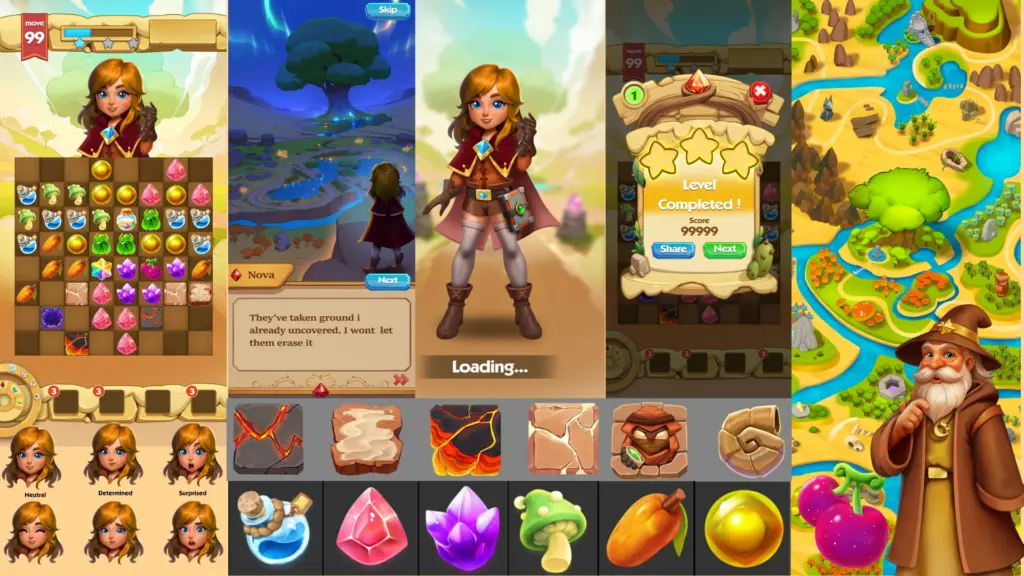
In this hybrid approach, art direction, visual identity, and key assets remain in-house. High-volume, execution-intensive tasks scale through 2D game art outsourcing, allowing production to expand without restructuring teams.
This model is particularly effective when internal teams are already operating near capacity. Outsourcing relieves execution pressure while preserving focus on high-impact work.
Hybrid pipelines also allow internal 2D game artists to concentrate on core game systems and UI work that require deep product knowledge, while external teams handle broader 2D art production needs. External teams absorb volume-driven production without disrupting internal iteration cycles.
As production demands fluctuate, hybrid pipelines provide resilience and operational flexibility. For many studios, this approach has become the industry standard rather than an exception.
How to Evaluate 2D Game Art Vendors
Portfolios are necessary but not really enough.
Decision-makers should also evaluate vendors across the following dimensions:
- Capability to follow art direction precisely and translate an art director’s vision into production-ready assets
- Consistency in maintaining style and brand alignment across large asset volumes
- Available capacity to support mass production with reliable delivery against agreed scope and quality
- Ability to operate as a long-term partner and scale alongside the game’s lifecycle
- Clarity in communication and feedback handling, even across time zones, with clear deadlines and turnaround expectations
- Robust IP security practices and data protection standards
- Defined revision structures and ownership boundaries
- Transparency in outsourcing budget planning and cost assumptions
- Demonstrated integrity, professionalism, and accountability in delivery
Reliable vendors articulate both their strengths and their limitations openly.
What to Look for in a 2D Game Art Outsourcing Partner
In practice, meeting the criteria above is less about promises and more about repeatable process. Studios that work successfully with outsourcing partners tend to prioritize operational maturity over scale alone.
In well-run outsourcing engagements, this usually shows up early. Style alignment is validated through clear briefs and small test scopes before production ramps. Feedback loops, revision boundaries, and delivery expectations are agreed upfront, not discovered midstream.
Thunder Cloud Studio follows this same approach in its production work. Engagements typically begin with focused style alignment and scoped test assets to confirm interpretation and consistency. Capacity is planned at the team level to support sustained output as scope scales.
Clear communication routines and documented workflows are used to manage feedback and deadlines across time zones. IP security and confidentiality are treated as baseline operational requirements.
This approach does not eliminate risk. However, it reflects how mature outsourcing partnerships are built gradually, through alignment, transparency, and reliability over time.
Making Your Decision: In-House vs Outsourcing
- 2D game art outsourcing is most effective when aligned with clear production realities and delivery expectations.
- In-house teams excel at style ownership and deep iteration, but face limits in capacity planning and rapid scaling.
- Studios often outsource 2D game art to reduce delivery risk during high-demand production phases.
- Hybrid models combine in-house direction with external execution to balance control, scale, and cost.
- Mature game art outsourcing services emphasize process, communication, and reliability over short-term cost savings.
Quick decision framework:
Choose in-house if: Stable demand + predictable roadmap + budget for fixed costs + continuous iteration needs
Choose outsourcing if: Fluctuating demand + need to scale quickly + specialized skills gaps + prefer variable costs
Choose hybrid if: Established team + growing content needs + want to maintain art direction + need flexibility