

Game production rarely slows down because of ideas. It slows down when assets fail to integrate at scale. In real projects, delays often appear when animations look approved in DCC tools but break once they hit engine systems. Therefore, in modern pipelines, in-game animation must ship ready, stable, and engine-compatible.
Studios searching for a 3D animation service are usually responding to production pressure rather than creative gaps. Capacity limits, schedule constraints, and delivery risk all surface at the same point: whether animation assets can enter the engine smoothly and support gameplay without friction.
This article reflects how Thunder Cloud Studio delivers asset-ready 3D in-game animation services for scalable production in Unity and Unreal Engine.
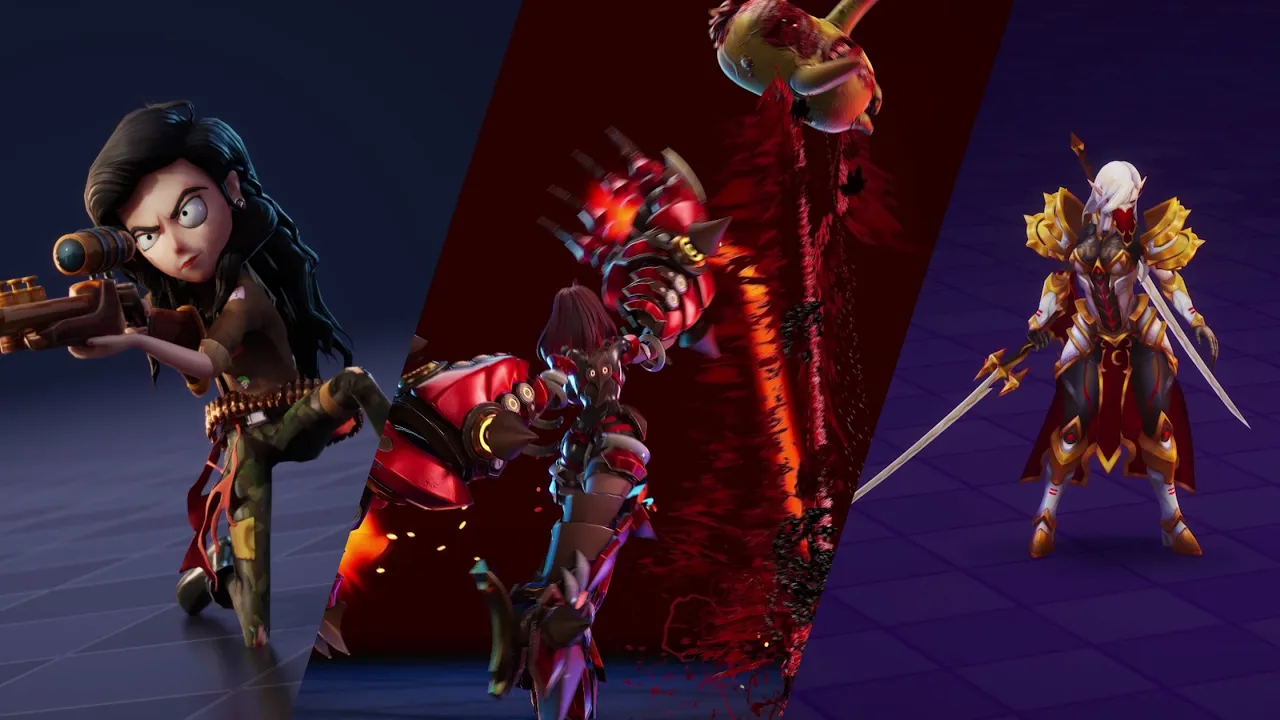
In-game character animation demo showcasing gameplay-ready locomotion, combat, and interaction animations authored for real-time engine integration.
What Makes Game Animation Actually Ready for Production?
At Thunder Cloud Studio, asset-ready 3D game animation reflects how reliably assets perform once they enter the engine. The service focuses on gameplay-driven animation that remains stable under real in-engine runtime conditions, not just visual review.
In other words, asset-ready delivery means animations arrive optimized and validated for production use. Thereafter, assets integrate directly into Unity or Unreal projects without cleanup, re-export, or technical rework.
In addition, production readiness is measured by behavior inside systems. Animations must blend correctly, respect state changes, and maintain consistent timing under gameplay logic.
Within Thunder Cloud Studio’s pipeline, these requirements are enforced early. Gameplay runtime behavior is validated during production, not after delivery, so issues surface before assets reach final integration. This approach reduces late-stage rework, prevents integration issues, and protects production timelines.
Understanding 3D In-game Animation Service Scopes
Within Thunder Cloud Studio’s service offering, asset-ready 3D game animation represents a deliberate area of specialization. The studio focuses on in-game animation assets designed to operate inside gameplay systems and real-time engines.
What Thunder Cloud Studio delivers are gameplay-critical animation assets, including locomotion, combat actions, and interaction animations. These assets are built to function within state-based animation systems, where blending, transitions, and gameplay-driven logic determine how animation performs moment to moment.
This specialization exists because in-game animation follows different technical rules than cinematic or cutscene animation. State machines, runtime blending, compression, and performance constraints shape how assets behave in-engine. Visual fidelity alone is not enough if animation fails under gameplay conditions.
By concentrating on engine-ready animation assets for Unity and Unreal Engine, Thunder Cloud Studio delivers work that integrates cleanly and behaves predictably at runtime. For clients, this specialization means working with a team optimized for gameplay systems, not a generalist approach designed for linear playback.
How Production-Grade Animation Pipelines Actually Work
At Thunder Cloud Studio, in-game animation production follows a structured five-stage pipeline. This model reflects production realities observed across multiple shipped titles.
The pipeline prioritizes repeatability, technical stability, and scalability.
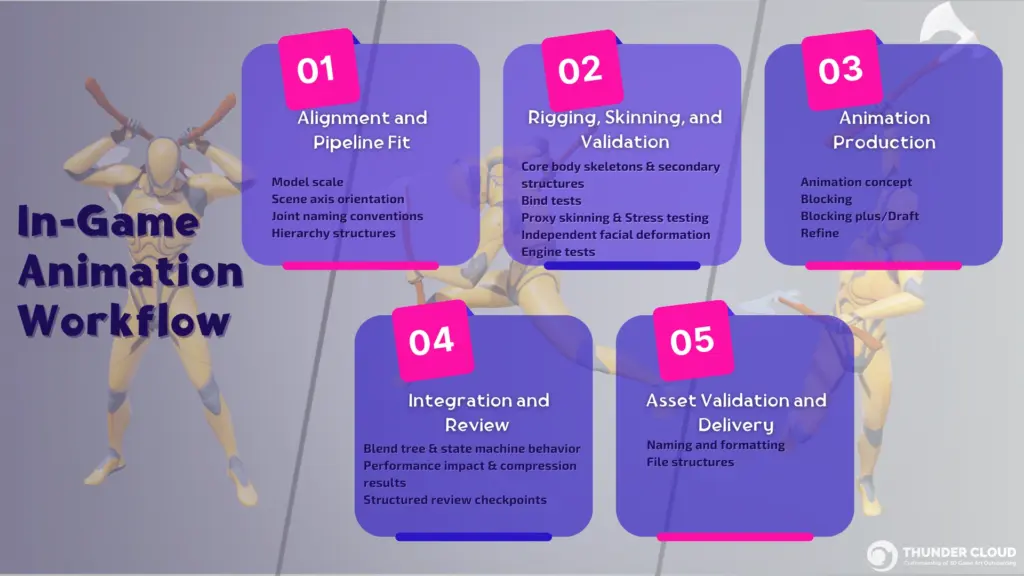
Thunder Cloud Studio's 3D In-game Animation Workflow
Stage 1: Alignment and Pipeline Fit
Before production begins, the studio typically checks animation assets for pipeline compatibility.
Key validation steps include:
- Model scale aligned with project standards
- Scene axis orientation matched to engine requirements
- Joint naming conventions reviewed
- Hierarchy structures verified
This alignment supports automation, reuse, and stable downstream integration.
Stage 2: Rigging, Skinning, and Validation
Rigging functions as a system layer, not a one-off task.
Core validation areas include:
- Core body skeletons and secondary structures established early
- Bind tests confirming joint placement and rotation behavior
- Proxy skinning before final skinning and stress testing
- Independent facial deformation validation
- Engine tests confirming deformation consistency after export
Read more about how Game Character Topology Supports Rigging & Skinning.
Stage 3: Animation Production
Animation progresses through controlled, repeatable stages.
Production phases include:
- Concept definition to establish intent and gameplay context
- Blocking focused on poses, timing, and pacing
- Blocking plus adding anticipation, recovery, and motion accents
- Draft passes transitioning motion into splined form
- Spline and refinement enhancing secondary motion and detail
Keyframes anchor motion throughout, enabling efficient iteration.
At scale, the studio designs animation systems for reuse rather than single-character execution. Modular animation sets allow locomotion, combat, and interaction behaviors to be shared across characters with minimal rework, reducing both production time and long-term maintenance cost.
Stage 4: Integration and Review
Animations are validated directly inside the engine.
In-engine review focuses on:
- Blend tree and state machine behavior
- Performance impact and compression results
- Iteration through structured review checkpoints
Runtime responsiveness directly inside the game engine: Unity’s Animator system or Unreal Engine’s Animation Blueprint framework.
Stage 5: Asset Validation and Delivery
Final animation assets follow production delivery standards.
Delivery readiness includes:
- Consistent naming and formatting
- Engine-ready file structures
- Immediate integration in Unity and Unreal projects
This pipeline supports scalable game 3D animation production, not one-off assets.
For live-service and long-term projects, asset-ready animation must remain update-safe. Consistent naming, version control discipline, and backward-compatible animation structures allow new content to be added without breaking existing gameplay systems.

Character animation tested in Engine

Scaling Game Animation Without Rebuilding Pipelines
How Many Animations Can a Scalable Pipeline Deliver?
Production capacity determines whether a 3D animation service can support AAA-scale projects. At Thunder Cloud Studio, the pipeline consistently delivers over 150 in-game animations per month – including full locomotion sets, combat sequences, and interaction animations – while maintaining stable quality.
See Battle Mage animation package – 35 polished combat animations including attack chains, special abilities, and hit reactions, delivered production-ready in 2 weeks.
This output is sustained through structured teams and disciplined workflows. Animators operate across multiple pipeline stages in parallel, with quality checks running throughout production.
Beyond baseline output, scalability extends beyond fixed capacity. Thunder Cloud Studio can scale further based on project demand, supporting larger volumes and a wider quality range from A to AAA. Resource preparation and team ramp-up typically take around 2–4 weeks.
Quality maintenance at scale remains consistent. Art direction and technical standards apply across all deliverables, ensuring new assets integrate cleanly into existing animation sets.
How Thunder Cloud Studio’s Pipeline Scale for AAA Projects?
Experience depth directly affects scalability and quality consistency. At Thunder Cloud Studio, over 13 years of game animation production shape how pipelines are built and maintained. This experience enables faster iteration and more stable delivery across the full animation lifecycle.
Scalability is reinforced by a strict, multi-layered QA system embedded into production. Quality checks begin with individual artist self-QA, then progress through supervisors, team leads, and division heads. For demanding projects, the art director also participates to ensure creative and technical alignment.
This QA structure is supported by standardized documentation covering technical checks, animation guidelines, and engine validation rules. The team customizes these documents per project and updated as requirements evolve, allowing teams to scale without losing consistency.
Skilled animators produce AAA-standard work efficiently without constant revision cycles. Deep 3D character animation understanding translates into nuanced, believable movement that enhances gameplay. Quality assurance systems maintain consistent standards across large animation volumes. Technical QA layers ensure every animation meets engine compatibility and performance requirements.
Technical proficiency across Unity and Unreal Engine eliminates integration friction. Thunder Cloud Studio’s approach, for instance, maintains flexible artist capacity that adapts to each project’s peak demands. This resource flexibility transforms animation production from a constraint into an enabler.
When Should Game Studios Outsource for 3D In-game Animation?
Why Studios Turn to External Animation Teams
Thunder Cloud Studio’s 3D animation services support studios at multiple production stages, for different operational reasons.
During pre-production, studios often avoid expanding internal teams because fixed overhead adds up quickly. Salaries, benefits, hiring, training, tools, and management costs create long-term commitments. External partners let teams prototype gameplay animation and validate direction without locking internal resources.
Mid-production is the most common outsourcing phase. Animation volume spikes once systems lock, but demand is usually temporary. Studios rely on partners that can scale fast, deliver large volumes quickly, and avoid permanent headcount expansion.
Post-production and live-service phases also benefit from outsourcing. Studios often require polish passes, new content, or iteration bursts while keeping internal teams lean. External animators handle these updates without adding ongoing overhead.
Outsourcing also gives studios access to specialized skills and mature pipelines. Instead of rebuilding animation systems or retraining teams, studios work with partners that already match required styles, technical standards, and engine workflows.
From a cost perspective, in-house teams carry fixed overhead across the entire development cycle. Outsourced game 3D animation scales cost with production demand. Studios often combine both models to balance cost, timeline, and delivery risk. A deeper breakdown appears in cost, timeline, and risk factors in 3D animation outsourcing.
A Practical Outsourcing Decision Framework
External animation services make sense when studios move from exploration into execution.
At this stage, teams typically evaluate partners across three high-level phases:
- Pipeline compatibility, to confirm engine workflows, file standards, and delivery fit
- Production alignment, to assess scalability, communication structure, and cost clarity
- Artistic partnership, to validate style adaptability and problem-solving ability
These steps help studios determine whether a provider can integrate smoothly and scale reliably. A deeper breakdown of this process is outlined in How Studios Evaluate Game 3D Animation Service Providers.
Asset-Ready Animation Enables Confident Scaling
At Thunder Cloud Studio, asset-ready 3D game animation services are built around the realities of scalable game production.
In conclusion, outsourced studios that align with these production principles tend to reduce integration risk as animation volume grows. A structured pipeline, early runtime validation, and repeatable delivery standards help animation remain predictable under real gameplay conditions. This approach allows teams to scale output without adding long-term overhead or destabilizing downstream systems.
For studios evaluating how to approach large animation libraries or production peaks, these takeaways offer a practical decision baseline.
To see how Thunder Cloud Studio applies this approach in real production, explore the 3D in-game animation service.
Key Production Takeaways:
- Asset-ready animation is validated for engine behavior, not just visual quality
- Scalable pipelines prioritize repeatability over individual craftsmanship
- In-engine testing is a production requirement, not a final check
- Structured delivery reduces revision cycles and integration risk at scale