

Outsourcing 3D animation services usually comes down to niche skill acquisitions, capacity, timeline pressure, and production focus. Studios usually outsource when internal teams need to stay on core development, hero assets, or other milestone-critical work.
However, the real question is not whether a vendor can do basic animation work, it is whether the team can scale with the roadmap while keeping quality, technical stability, and gameplay consistency intact. That is the real test of a production-ready 3D animation service.
This is also why asset-ready 3D game animation matters early in vendor evaluation. Scalable game animation outsourcing only works when the 3D animation workflow is stable with internal QA layers and integrable pipeline.
TL;DR
- The strongest game animation outsourcing partners do more than add capacity. They turn animation quality into a scalable production system that protects roadmap, gameplay consistency, and technical stability under volume.
- What stands out is not only workflow structure, but also how animator judgment is translated into shared direction standards, review language, approval gates, and clean publish discipline across every stage.
- For AA and AAA production, the real differentiator is planning maturity: the ability to assess scope early, structure batches intelligently, protect boundaries, and keep quality predictable as deadlines tighten.
A production-ready game animation outsourcing studio should prove scale in practice, from pilot validation to recurring delivery, with disciplined review flow, maintainable handoff, and batch throughput that remains reliable at AAA expectations.
Why Scalability Is the Real Test of a 3D Animation Service
For experienced game studios, outsourcing always comes down to two connected questions: whether the external animation team can execute the work at the required quality level, and whether the partner can scale with the production roadmap without losing consistency, technical stability, or delivery control.
Moreover, AA and AAA titles usually come with tighter milestone planning, more layered approval structures, and higher expectations for both technical quality and motion consistency. As scope grows, tolerance for delivery drift drops quickly.
Therefore, scalability should be treated as a production-management capability. A strong 3D game animation studio must be able to take a defined scope, assess timeline pressure, manage tasks effectively, and commit to delivery in a way that supports the studio’s roadmap.
In practice, scalable game animation outsourcing services must do several things at once. They need to protect gameplay consistency, keep review loops efficient, and maintain organized handoff standards while volume increases. At the same time, they need to understand when capacity can expand safely and when scope planning needs to tighten before production begins.
That is where mature vendors begin to separate themselves from task-based suppliers.
What Makes a Game Animation Studio Ready for Scalable Production?
In outsourcing partnerships, the real question is whether both sides can operate in a way that protects roadmap pressure, quality targets, and production stability at the same time.
From that perspective, a strong game animation outsourcing model usually depends on four things:
- Planning capability. This is often the real separator. Professional game art vendors do not wait for risk to appear. They assess dependencies early, design batch strategy before kickoff, and build delivery logic around both quality and schedule.
- Pipeline compatibility. External production stays sustainable when the outsourcing studio can work comfortably inside existing management tools, review systems, approval habits, and technical expectations.
- Consistency at set level. A few strong clips are not enough. The full package still needs to hold together across 3D character animation sets, gameplay states, and supporting actions.
- Delivery cleanliness. Unclear notes, loose file structure, and messy publish standards create avoidable cost. In contrast, disciplined packaging supports long-term production reliability.
Together, these criteria show whether a game animation outsource relationship can scale in a controlled way. More importantly, they become visible in the workflow itself, because a mature outsourcing studio expresses planning, compatibility, consistency, and delivery discipline clearly at every production stage.
The Workflow Behind Scalable In-Game Animation Production
In high-volume outsourcing, workflow is where scalability becomes visible. It shows how an outsourced studio plans production, protects quality, and keeps delivery stable as scope expands. At each stage, the key question is not how the work is done, but what that stage is meant to secure for the project.
Stage 1: Animation Concept and Motion Direction
Animation concept and motion direction is the pre-production stage where the intended action, performance tone, and movement language are defined before animation execution begins.
At scale, this stage is less about loose exploration and more about locking motion intent early. Its role is to define rhythm, pose language, silhouette readability, timing direction, and the overall movement vocabulary before the shot enters execution.
The expected outcome is not visual polish, but a clear performance target. An experienced outsourcing studio should be able to return a concise motion proposal supported by strong references, animation rationale, and a studio note that connects the requested action to gameplay function, creative direction, and expected player read.
This phase also exposes one of the most important requirements in an outsource pipeline. Strong animation teams need strong visual judgment, refined posing sensibility, solid physical common sense, and the ability to make the feeling of a pose read immediately through balance, line of action, weight distribution, and appeal. In a scalable outsourcing studio, that skill cannot remain individual only. It has to be translated into review language, direction standards, and approval criteria so multiple animators can hold the same performance level across the batch.
As a result, this stage protects scope definition, reduces interpretive drift, and gives both sides a shared performance target before execution starts.
Stage 2: Rigging Preparation for Animation Execution
Rigging preparation for animation execution is the stage where the character setup is validated and prepared so the animation team can work on a stable, production-ready rig.
This stage remains foundational because animation scalability depends on rig stability. At Thunder Cloud Studio, the rigging scope can extend from standard body rigging to full facial rigging when the project calls for it, allowing the setup to stay aligned with the broader animation pipeline. The objective is to ensure that the setup is production-ready, technically clean, and ready to support iteration without introducing avoidable friction. At the same time, rig readiness is closely tied to deformation quality, which still depends heavily on sound mesh preparation and character topology for animation.
Expected outputs at this stage include organized rig delivery, clean Maya data, preview materials, and a direct review path through SyncSketch. Together, these deliverables do more than support review. They establish a clean technical baseline for the rest of the pipeline, reduce avoidable friction in later stages, and make the production stream easier to scale as more animators, assets, and review cycles enter the workflow.
Operationally, the value is straightforward. Stable rig preparation reduces rework exposure, supports cleaner blocking, and makes the asset easier to maintain as more animators enter the production stream.
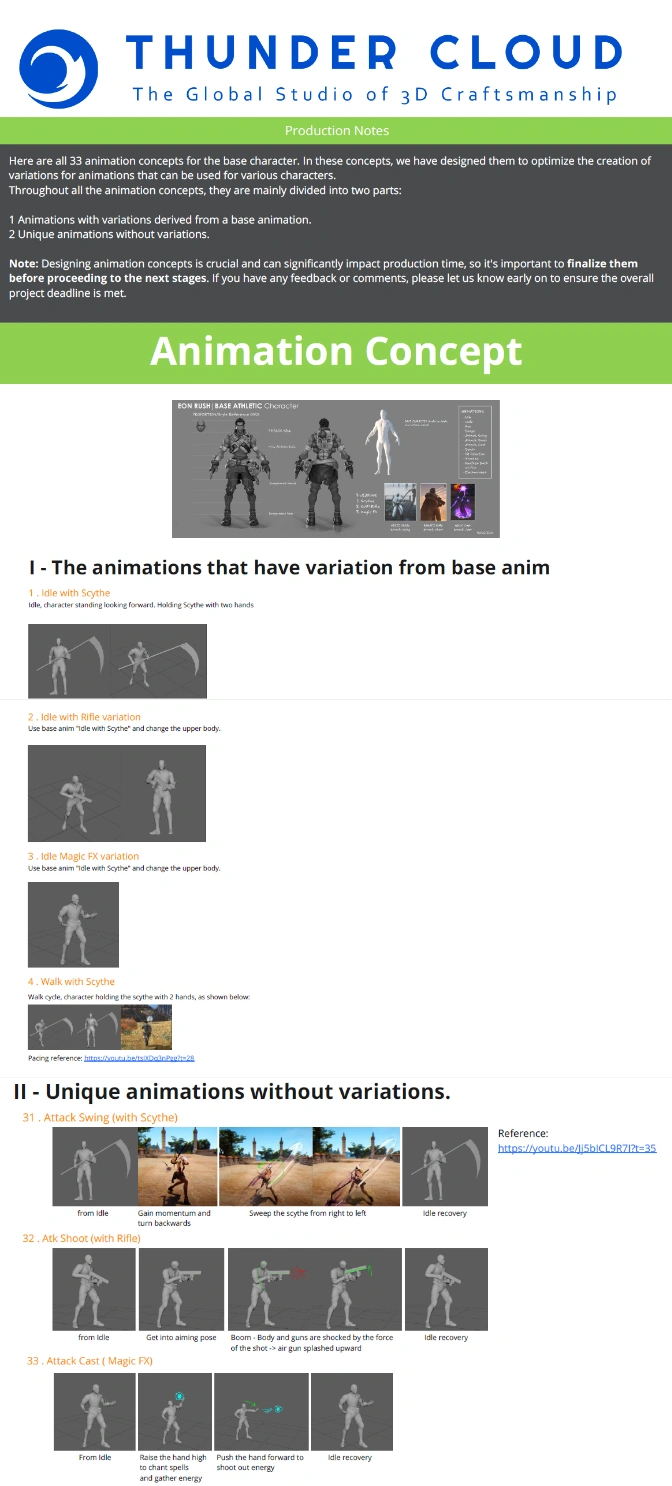
Snippet of a typical Animation Concept by a game animation outsourcing studio to client
Stage 3: Blocking for Motion Readability
Blocking is the stage where the main key poses and broad timing structure of the shot are established for directional review.
Blocking is the stage where the animator determines the key poses while establishing the overall timing of the shot. At this point, the goal is not smooth interpolation or polished body mechanics. Instead, the goal is to lock the major posing and timing decisions clearly enough for directional review.
The key deliverables at this stage are:
- a clear and visually satisfying silhouette
- a readable action sequence
- poses that hold up from key gameplay camera angles, including front, side, and three-quarter views
- timing that reads clearly enough to communicate motion intent, weight, speed, and impact
- blocking that does not yet depend on refined Graph Editor curves or overly committed body mechanics
Taken together, these results define whether the animation has a strong structural base. In a scalable outsourcing workflow, good blocking keeps review focused on pose design, action clarity, and timing logic while changes are still efficient. Consequently, once blocking is approved cleanly, later stages can move forward with much better predictability across the batch.
Stage 4: Blocking+ or Draft for Arc and Rhythm
Blocking+ or Draft is the stage where blocking begins to evolve into readable motion through stronger arcs, clearer timing transitions, and a more credible sense of performance.
Blocking+ is one of the most important stages in the entire workflow because it directly affects final delivery quality. For an outsourcing studio to run an effective pipeline at scale, the animation at this stage already needs to feel reasonably animated, with key poses strong enough to reflect the 12 principles of animation and timing clear enough to communicate weight, movement, speed, force, and ease in and ease out.
This is also where an experienced studio’s perspective becomes visible. Strong Blocking+ shows whether the team can move beyond structural posing into convincing motion while still keeping the workflow controlled. In scalable production, that matters because this stage gives the clearest signal of whether the animation is progressing toward final quality in a way that remains both creatively reliable and operationally predictable.
Examples of the progression from Draft to Refine stage in in-game animation:
Stage 5: Refine Body, Accessories, and Secondary Motion
By the time the work reaches refinement, the structural direction should already be settled. The focus here shifts to execution-level motion quality, including body mechanics, timing discipline, fluidity, final pose resolution, accessories, and secondary motion.
The production value of this stage is not simply polish. More importantly, refine should be used for enhancement rather than correction. Primary body action and supporting motion should now resolve into one cohesive performance with the same level of intentionality across the asset.
That distinction is critical in game 3D animation outsourcing. Once refine is forced to solve problems that should have been addressed earlier, schedule reliability and batch predictability begin to weaken. In a scalable workflow, this stage should bring the animation package to completion, not reopen structural issues that disrupt the rest of the batch.
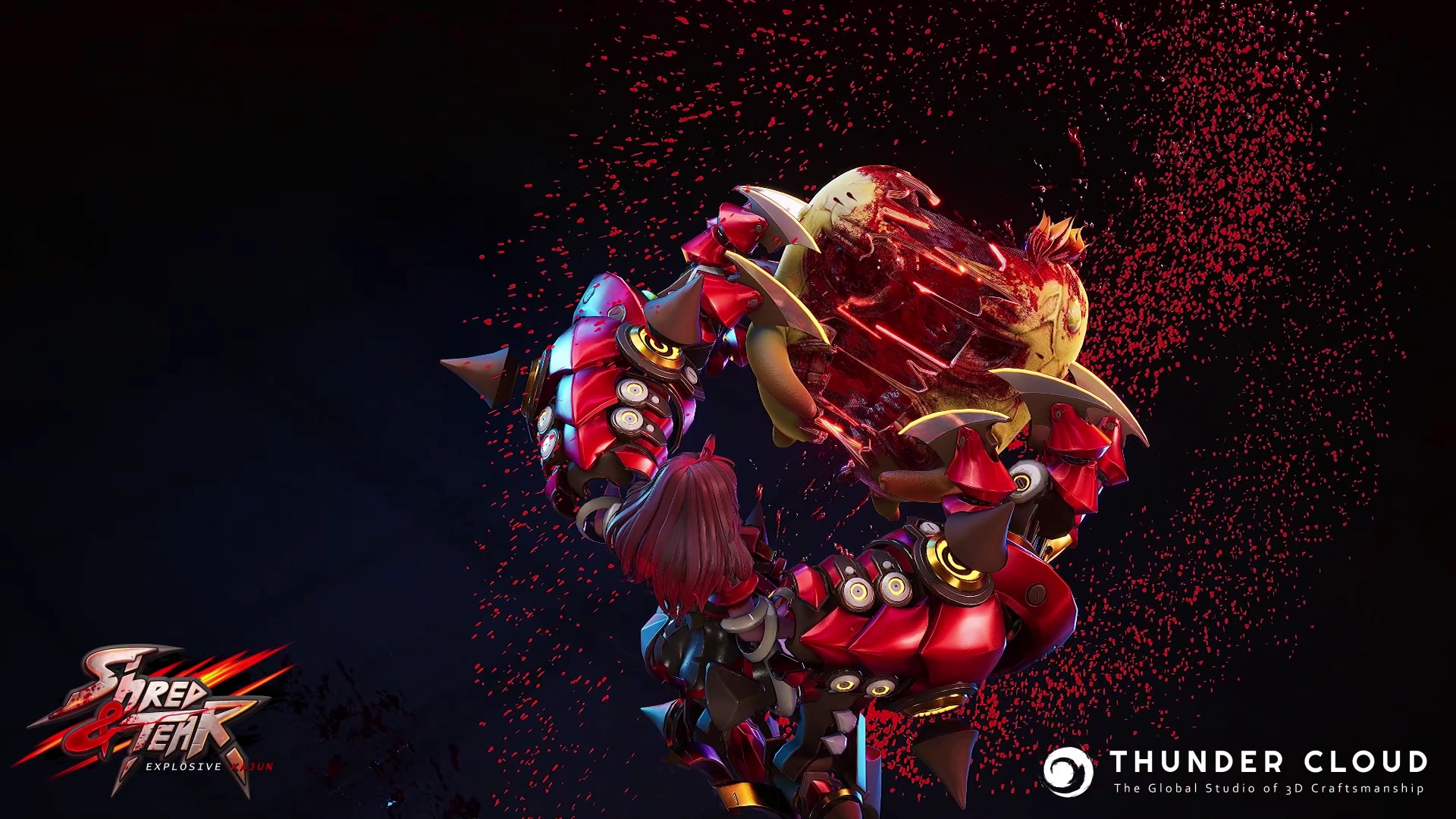
The execution quality described across these stages is visible in Thunder Cloud Studio’s delivered work. Two examples of in-game character animation Shred and Tear and SOTA show how the blocking-to-refine pipeline resolves into final character performance.
Deliverables, Review Flow, and Approval Gates Across the Pipeline
In scalable outsourcing, stage deliverables and approval gates should function as one review system. Each update needs to show progress clearly, give the client enough visibility to evaluate the work with confidence, and leave behind organized data that supports the next stage without creating maintenance friction.
Thunder Cloud Studio structures every delivery around a four-part package: an MP4 preview via SyncSketch for direct annotation, a studio note connecting the update to the stage goal, clean Maya scene data, and a publish folder with FBX and asset-status visibility. This structure means a client can evaluate any update in under ten minutes without chasing files or context. For rig-related stages, the package also includes rig FBX data. For animation stages, the publish structure should maintain clear preview, note, and asset-status visibility so the client can follow what has changed, what is ready for review, and what still needs alignment.
Accordingly, approval discipline becomes critical. In a well-structured workflow, the client does not wait until final delivery to react. Instead, progress is reviewed stage by stage, usually through SyncSketch for direct visual comments and annotations, with studio notes and preview files providing context around the update. Feedback should stay specific to the goal of the stage:
- Concept: feedback should focus on motion intent and direction.
- Blocking: feedback should focus on pose clarity, silhouette, action sequence, and timing logic.
- Blocking+: feedback should focus on motion quality, arc, rhythm, and whether the animation is progressing credibly toward final.
- Refine: feedback should stay focused on final execution quality rather than reopening earlier structural decisions.
The approval gates themselves usually fall into three categories:
- Visual approval: motion direction, readability, timing intent, and fit with the project’s style language are confirmed.
- Technical approval: export cleanliness and publish discipline are checked before the work moves forward. Maya scenes should be cleaned, unnecessary reference data removed, and FBX export handled with discipline. The publish data folder should include the FBX rig file and picker file where needed, along with animation notes, preview video or SyncSketch link, and asset-status visibility.
- Engine test and stress test: before final delivery, the animation should also be validated in engine to confirm stable behavior under actual runtime conditions. That includes checking whether the animation integrates cleanly, holds up in the intended gameplay state, and does not introduce avoidable issues when multiple assets, transitions, or gameplay scenarios are stressed together.
As a result, clear deliverables and clean approval logic reduce ambiguity at every stage. They make feedback easier to process, lower avoidable rework, and keep the batch more predictable as volume scales. Good outsourcing does not only move the animation forward. It also keeps the entire review, validation, and handoff pipeline easier to supervise.
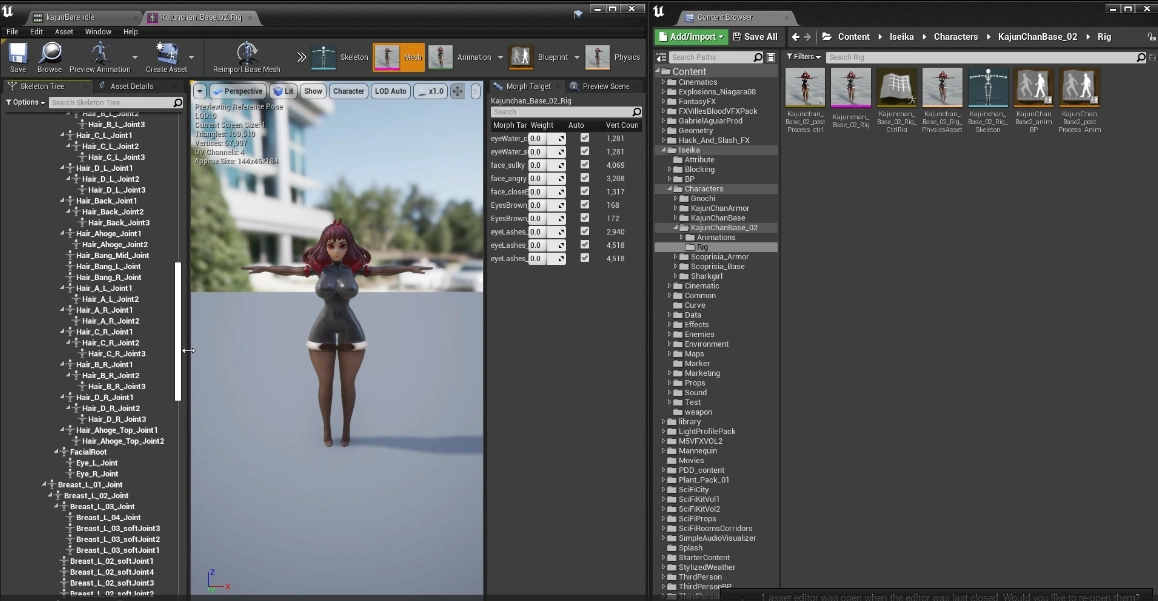
3D animation service pipeline example with character animation tested in engine to verify rig setup, morph targets, and asset readiness in Unreal Engine.
What Breaks Scalability in Game Animation Outsourcing
Scalability usually breaks at the management level before it breaks at the animation level.
One common issue is missing or inaccurate data at the start. If the brief, technical assumptions, or expected scope are unclear, even a strong animation team can begin from the wrong baseline. A complete outsourcing brief typically covers: the animation list with animation references, the target engine and rig format, the reference character or base skeleton, any existing style guides, and the milestone date the batch needs to hit. Studios that provide this upfront consistently see faster concept approval, fewer revision rounds, and more accurate delivery estimates from their outsourcing partner.
Another issue is expectation misalignment. This can include quality targets that are not fully defined, priorities that shift too late, or approval logic that changes during production.
Communication structure is another pressure point. If progress updates are inconsistent, or if the client-side point of contact changes midstream, the external team can lose alignment even when the work itself remains strong.
Scope pressure also needs realistic control. In some cases, game studios may request a quality level that pushes beyond the agreed scope, especially after internal direction changes. That is understandable in live production. However, without careful planning and change control, it can destabilize both deadline and batch quality, not to mention create out-of-scope cost.
At a larger scale, these problems do not only affect one asset. They begin to affect milestone confidence. That is also why they connect closely with the broader evaluation logic covered in how studios evaluate production-ready 3D in-game animation services.
What Mature Production Management Looks Like in a Game Animation Outsourcing Studio
The strongest production management systems are designed to solve those risks directly.
A professional 3D game animation studio such as Thunder Cloud Studio usually shows that through a few core traits:
- Defined project governance: each project is assigned a dedicated coordinator, a project lead for oversight, and a team whose size and seniority match the tier and scope.
- Flexible capacity planning: the team can scale from pilot scope to larger batches without destabilizing the workflow.
- Layered QA: multi-level review, from individual artists to senior artists and leads, catches issues early, reduces back-and-forth revisions, and keeps the pipeline maintainable.
- Operational flexibility: the studio adapts comfortably to client tools, review systems, and production models.
- Predictability: the partner demonstrates planning discipline, not only animation execution.
That level of control should also appear in the actual delivery scale. In one AAA action RPG project, Thunder Cloud Studio began with a 4-animation pilot with medium to complex tier animations for a character – the progress from start to client’s approval took around a week. Over the following four months, scope expanded to monthly batches covering three to five characters with five to ten animations each with mixed complexity tiers. The first mass volume batch reached 87 animations for seven characters in a single month, running in parallel with four other active projects at the studio. A standard pilot engagement typically covers 3-5 animations across one character, with a 5-7 business day turnaround, which is enough to validate workflow compatibility before committing to a full batch.
With Maya retargeting and a reusable Unity Humanoid skeleton base, a production-ready studio can deliver 30-40 simple to medium-complexity animations per week – the equivalent of covering a full supporting character set in a single sprint.
For outsourcing managers and producers, that is the practical proof point behind game art outsourcing decisions: whether the external team can absorb volume without weakening roadmap confidence.
Choosing a 3D Animation Service for Sustainable Scale
A scalable vendor should show more than good clips. It should show a reliable production system.
That means clear stage objectives, strong planning before kickoff, realistic batch proposals, disciplined review flow, organized publish structure, and quality control that still holds under volume. It also means recognizing that technical readiness remains part of production management, from rig stability to sound mesh preparation and character topology for animation.
Studios that choose a partner on pipeline maturity usually reduce more risk than studios that choose on visual samples alone. The value of a scalable 3D animation service is not simply added external capacity. It is the ability to meet animation demand without losing control of quality, delivery structure, or milestone confidence.
As scope grows, game animation outsourcing only remains effective when the external team can plan, execute, review, package, and scale in a controlled way. When that system is mature, outsourcing becomes a production advantage rather than a production compromise.
Studios looking to evaluate Thunder Cloud Studio’s pipeline approach can review our in-game animation services or reach out directly to discuss scope and batch requirements.